Marichyasana A: Your First Bind in the Ashtanga Primary Series
Marichyasana A is the moment the Ashtanga Primary Series stops asking you to fold and starts asking you to wrap. It is the first of four seated poses named after the sage Marichi, and the first place in the whole series where your arms travel behind your back to find each other. For most beginners the hands do not meet for months, and the pose still does its work long before they do.
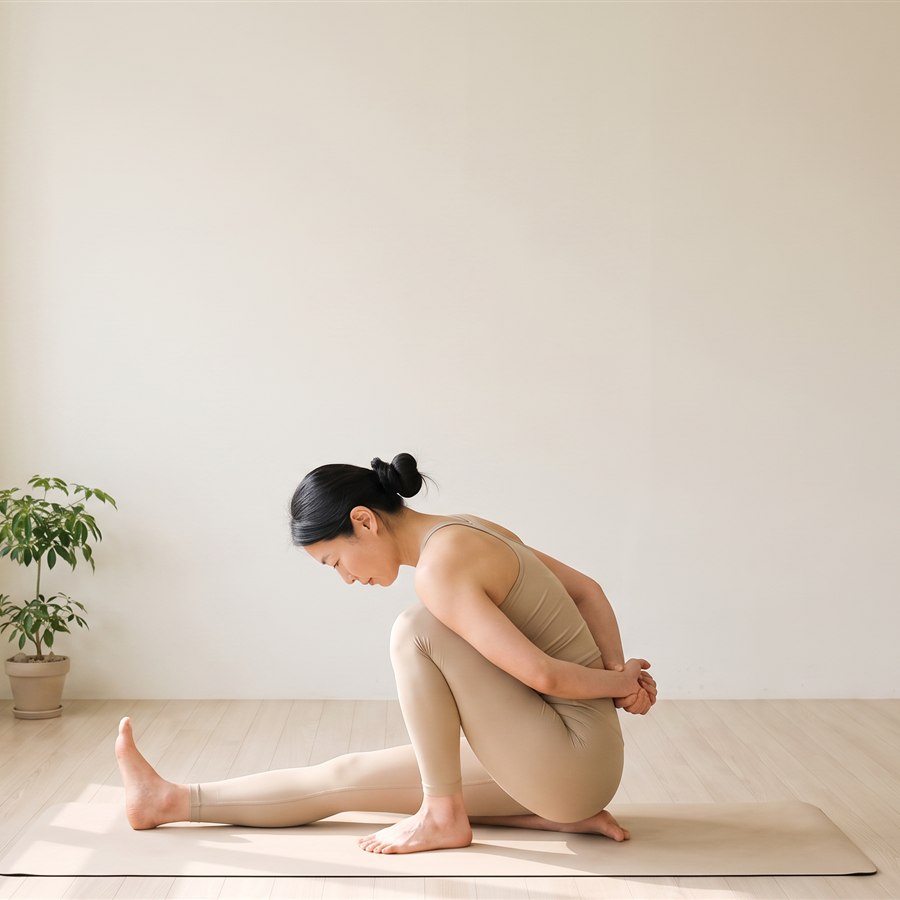
Marichyasana A - chest folded over the straight leg, arms wrapped behind the back
What is Marichyasana A?
Marichi is a sage of Indian mythology, traditionally described as a son of Brahma and a grandfather of Surya, the sun. Asana simply means seat or posture, so Marichyasana is "Marichi's pose." The Primary Series gives us four versions of it, labelled A, B, C and D, and they all share one structural idea: one knee folds up tight against the body, and the arms use that folded leg as an anchor.
In the A version you sit with one leg straight in front of you and the other foot planted close to your sitting bone. You wrap one arm around the standing shin, reach the other behind your back, join the hands, and fold forward over the straight leg. Practitioners often say this is the pose that finally taught them what a forward fold feels like from the inside. With a knee pressed into your belly, you cannot round your way into the shape. You have to lengthen instead.
Where it sits in the practice
Marichyasana A follows Janu Sirsasana, which we covered in the last two posts, and it borrows a great deal from it: the same asymmetrical seat, the same question of whether both hips can stay level on the floor. What is new is the wrap. Until now your hands have reached forward, down, or up. Here they reach backward and around, and suddenly your shoulders, not your hamstrings, are the thing holding you up.
That change of limiting factor is the whole lesson. A practitioner with open hamstrings may find this pose humbling, while someone who has always struggled to touch their toes may bind on the first try because their shoulders are mobile. Neither outcome says anything about how well you practise.
Step by step: getting into Marichyasana A
- Sit in Dandasana with both legs straight, hands beside your hips, and the whole spine tall. Take one full breath here before you change anything.
- Bend your right knee and plant the right foot flat on the floor, roughly a fist's width in front of the right sitting bone and in line with it, not out to the side. The shin should stand close to vertical.
- Keep the left leg awake: thigh muscles engaged, kneecap lifting, toes pointing up at the ceiling, heel pressing away from you.
- Inhale and reach the right arm forward along the inside of the right shin. Turn the thumb down so the palm faces outward, then sweep the arm around the shin as though hugging it. The shin stays glued to the right side of your ribs the whole time.
- Exhale and take the left arm behind your back, reaching for the right hand or wrist. If they do not meet, hold a strap or a rolled towel between the two hands instead.
- Inhale and lengthen the spine, lifting the chest away from the hips.
- Exhale and fold forward over the straight left leg, leading with the chest and the chin rather than dropping the forehead first.
- Stay for five slow breaths. Keep pressing the right foot down and keep the left leg strong.
- Inhale, lift the head and chest. Exhale, release the hands and return to Dandasana. Take a vinyasa if you are practising the full form, then repeat everything on the second side.
The state of the pose always arrives on an exhale, and you hold for five breaths on each side before moving on. If you are practising at home without a vinyasa between sides, simply sit tall in Dandasana for one breath and switch legs.
Breath and gaze (drishti)
Keep the ujjayi breath you built in the early posts of this series: a soft, audible hiss made at the back of the throat, with the inhale and exhale roughly the same length. The bind and the compression against the belly will tempt you to hold your breath. The moment you notice that, you have found your edge. Back out a few centimetres until the breath flows again.
The drishti for Marichyasana A is nasagrai, the tip of the nose. That gaze keeps the back of the neck long and stops you from craning your head toward your shin to fake a deeper fold. If your forehead is nowhere near your leg, let the eyes stay soft and look down past the nose at the floor; the direction matters more than the distance.
The bind, told honestly
Whether your hands meet behind your back depends on four things you did not choose: the length of your arms, the mobility of your shoulders, the depth of your forward fold, and the space between your ribs and your thigh. Only two of those change quickly with practice. A strap is not a lesser version of this pose. Hold one end in each hand and walk the fingers closer over the weeks, and you get exactly the same work through the spine and shoulders that the full bind provides.
The bind is a result, not a technique. Chasing it by yanking the back arm is the fastest route to an irritated shoulder, and an irritated shoulder will cost you more practice days than the bind is worth.
Common mistakes
- Planting the foot too far away. If the heel drifts forward, the shin tips away from your torso and the arm has nothing to wrap around. Fix: slide the heel back until the shin is nearly vertical and the calf almost touches the hamstring.
- Rounding the spine to reach the hands. Beginners often collapse the chest to buy a few centimetres of reach. Fix: take the strap, lift the chest, and fold from the hip creases rather than the middle of the back.
- Letting the straight leg go to sleep. The extended leg tends to roll outward and go soft once all the attention moves to the arms. Fix: press the back of that thigh down, turn the toes slightly inward, and keep the foot flexed.
- Collapsing onto one hip. The bent-knee side often lifts off the floor as you twist toward the bind. Fix: sit on a folded blanket and consciously weight the sitting bone on the bent-knee side before you fold.
Beginner modifications
Sit on a folded blanket or a firm cushion. Raising the hips even five centimetres tips the pelvis forward and makes the fold available without any extra hamstring length. This is the single most useful change most beginners can make to the seated sequence.
If the bind is out of reach, use a strap, or simply place both hands on the floor on either side of the straight leg and fold with a long spine. You can also keep a gentle bend in the straight knee for the first few months; a slightly bent leg with a long back teaches far more than a locked leg with a rounded one.
When to be careful
Skip or heavily modify this pose if you have a shoulder injury, a sore rotator cuff, or any pain when you reach an arm behind your back. The same goes for a recent hamstring tear, where the deep forward fold over a straight leg is the exact movement that keeps re-injuring it.
Because the bent knee presses firmly into the abdomen, this pose is not appropriate during pregnancy or after recent abdominal surgery. If you have a disc injury in the lower back, keep the spine long, fold only to where the back stays straight, and sit up high on a support. As always, less depth with better alignment is the version that lets you keep practising.
🧘 Want to practice this pose right now? Open our interactive guide with photos, alignment details and a breath timer: Ashtanga Shala Practice Guide.
Give yourself permission to spend a few weeks with a strap here. Marichyasana A rewards patience more obviously than almost anything else in the Primary Series, and the shoulders open on their own schedule. In the next post we move on to Marichyasana B, where the same bind has to happen with one leg folded into half lotus.
This post is general guidance, not medical advice. If you have an injury or health condition, check with a professional before practicing.


