Triangle Pose (Utthita Trikonasana): It's Not About Touching Your Toe
After the two forward folds, the practice turns sideways. Padangusthasana and Padahastasana asked you to go down; Trikonasana asks you to go out — and that small change is where a lot of students quietly lose the thread. In a morning room full of practitioners you can hear it happen. The ujjayi that was steady through the folds turns thin and short the moment the hand starts hunting for the toe.
So let me say the useful thing first. The triangle is not a pose about reaching your foot. It is a pose about staying long while you turn.
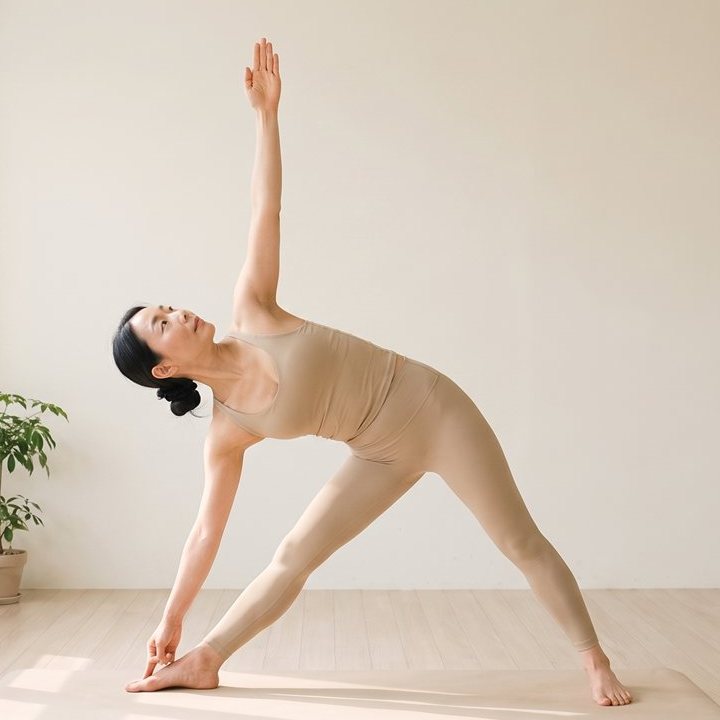
Utthita Trikonasana — the chest stays open as the torso turns.
How you get in, breath by breath
From samasthiti, inhale and step or lightly hop the feet apart, arms opening to the sides at shoulder height. The distance is roughly one leg-length — in the traditional measure, the right hand should be able to find the right foot without the ribs collapsing. Turn the right foot out ninety degrees, and turn the left foot very slightly in. Both heels stay grounded, the whole outer edge of the back foot pressing down.
Exhale and extend sideways over the right leg, taking the right big toe with the thumb, index and middle finger. The left arm reaches straight up, in one line with the right. The gaze — hastagrai drishti — goes to the raised thumb. Stay five breaths. Inhale to come up, exhale to turn the feet, and repeat on the left for five. Then the same footing serves the revolved version, and after that you come back to samasthiti.
Five breaths sounds like nothing until you are in it. Each one should be audible and even, the soft sea sound at the back of the throat, the same length going in as coming out. If your exhale is twice as long as your inhale, you are not breathing — you are leaking. Come up a little, and let mula bandha do some of the work your jaw is trying to do.
Utthita Trikonasana — the whole side body long, chest turning up, gaze to the raised thumb.
Length before depth
Watch what most students do to get the fingers on the toe: they round the upper back, drop the chest toward the floor and let the top shoulder roll forward. The hand arrives. The pose leaves.
Try the opposite order. Reach sideways first, as if someone were pulling your right wrist away from your left hip, until you feel the waist on the top side stay just as long as the waist underneath. Only then let the hand come down to whatever it reaches — toe, ankle, shin. The chest keeps turning toward the ceiling. The front leg stays firm with the kneecap lifted, and the weight stays in both feet, not poured into the front one.
I still catch myself sinking here on stiff mornings, and the fix is always the same: press the back heel down harder. The pose lengthens from the back foot, not from the front hand.
The revolved side
Parivrtta Trikonasana — square the hips first, then rotate; the back heel stays down.
Parivrtta Trikonasana uses the same stance, but now the hips square toward the front foot before anything twists. Exhale, place the left hand on the floor outside the right foot, right arm up, gaze to the raised hand. Five breaths, then the second side.
The order matters. Square, then turn. If you rotate before the hips have come around, the twist happens in the lower back instead of the upper spine, and you will feel it later in the day rather than in the pose.
Watch out
Three places to be careful. The hamstring attachment at the sitting bone: a sharp, pinching line at the very top of the back of the thigh means back off now — that tissue heals slowly, and I learned that the hard way in my early years of practice. The front knee: keep it strong but never locked hard back into hyperextension; a micro-softening protects the joint. And the lower back in the revolved pose: if the twist feels like a wringing sensation low and central, come up.
Good substitutions, all of them honest practice: hold the shin instead of the toe; take a block or fingertips to the floor in the revolved version; shorten the stance a few centimetres. Never bend the front knee to reach further, and never let the back heel lift just to get the hand down. A shorter triangle with an even breath is worth more than a deep one with none.
The vinyasa count will keep moving whether or not your hand touches anything. Let the breath be the thing you accomplish.
Reach out before you reach down — the triangle gives what it has to those who stop pulling.

