Half-Bound Lotus Standing Fold (Ardha Baddha Padmottanasana): Knee Safety Before Shape
The standing sequence has asked you to fold, twist, stretch and balance. Now, in Ardha Baddha Padmottanasana, it asks for something different: to place one foot into half lotus, reach behind your back for the toe, and fold forward on one leg. This is the first pose in the Ashtanga Primary Series where a beginner can genuinely hurt themselves by being enthusiastic, so it is also the first pose where the smartest practice is often the smallest one.
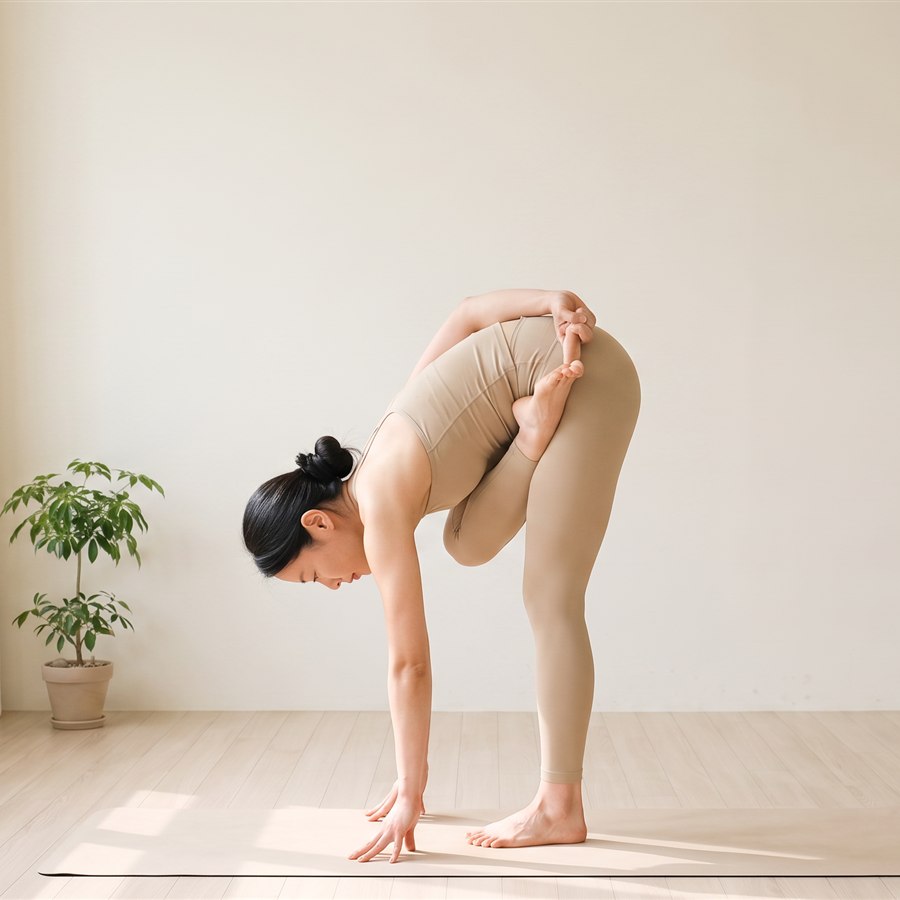
Ardha Baddha Padmottanasana - top foot high in the hip crease, heel drawn toward the navel, spine long over the standing leg
What is Ardha Baddha Padmottanasana?
The name breaks apart cleanly. Ardha is half, baddha is bound, padma is lotus, and uttana means an intense stretch. So: the half-bound-lotus intense stretch, standing. One foot comes into half lotus on the opposite thigh, the same-side arm wraps behind the back to catch the big toe of that lotus foot, and then the whole shape folds over the standing leg.
Three things happen at once. The bound arm rotates the shoulder back and opens the chest, the lotus leg asks for external rotation from deep in the hip, and the standing leg does the same hamstring work you have already met in Padangusthasana and Parsvottanasana. Practitioners often describe it as the pose that first taught them the difference between a hip that opens and a knee that gives way — usually because they learned it the hard way.
The rule that matters more than the shape
Here is the single most important sentence in this post: the rotation for half lotus comes from the hip, never from the knee.
The knee is a hinge. It bends and straightens, and it tolerates almost no twisting. When the hip is tight and you pull the foot up onto the thigh anyway, the rotation the hip refused to give has to come from somewhere, and the knee joint is what gives it. That is how meniscus and ligament irritation happens in lotus positions — not in a dramatic moment, but quietly, over weeks of forcing.
So before you attempt half lotus standing, spend time sitting in the shape that trains the same action without any load on the knee. Sit with the soles of the feet together and the knees dropping out to the sides, and simply breathe there.
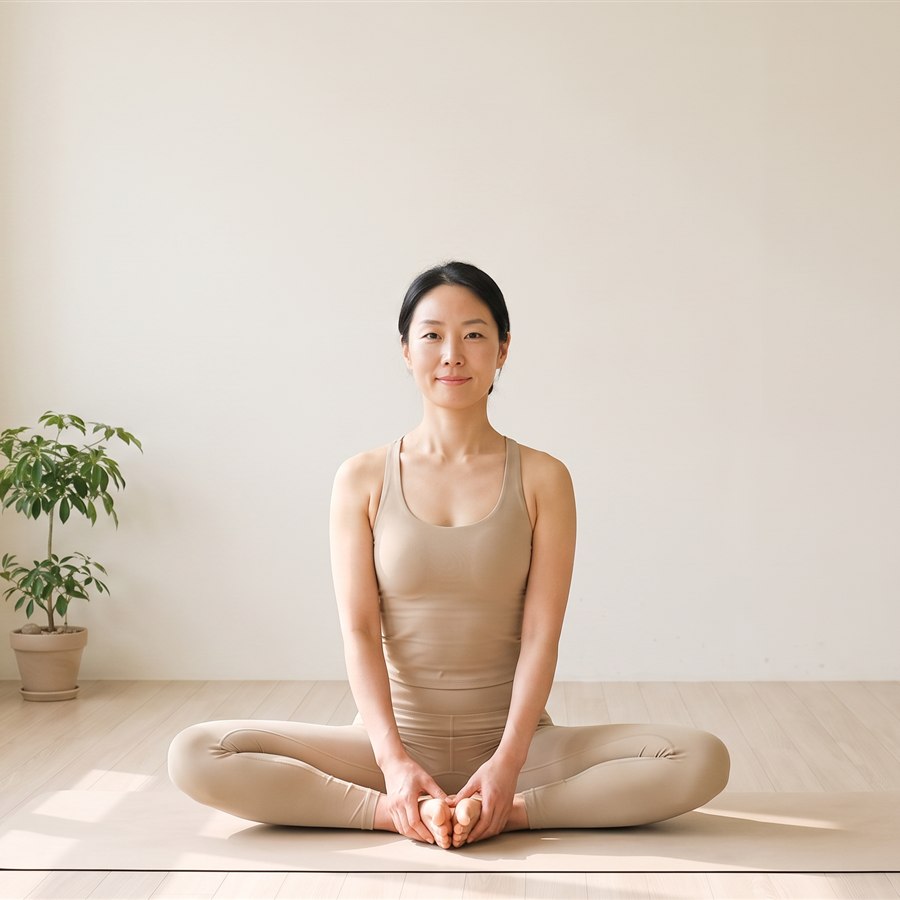
Baddha Konasana - soles together, knees released outward, external rotation coming from the hip joint rather than the knee
If your knees float high above the floor in that seated shape, your hips are not yet ready for standing half lotus. That is information, not failure. Practice the modifications below and let the hip open on its own schedule.
Step-by-step: getting into the pose
- Stand in Samasthiti at the front of the mat, weight even through both feet, breathing steadily.
- Inhale. Shift your weight onto the left foot. Bend the right knee and lift the right foot with both hands — one hand at the ankle, one under the foot.
- Draw the right knee out to the side first, opening from the hip. Only then place the right foot high on the left thigh, close to the hip crease, sole turned upward.
- Let the right knee soften downward. If it points out sideways at chest height and will not descend, stop here and use a modification.
- Exhale. Reach the right arm behind your back, around the waist, and take hold of the right big toe. If the toe is out of reach, the modification section has three ways in.
- Inhale. Place the left hand on your hip, lengthen the spine, and lift the chest so the front body is long before you fold.
- Exhale. Hinge from the hip and fold forward over the standing leg. Set the left hand on the floor beside the outer edge of the left foot, fingers in line with the toes.
- Let the chin move toward the shin. Keep the standing leg firm, kneecap lifted, without locking the joint back hard.
- Stay for five breaths.
- Inhale. Lift the head and straighten the arm, chest forward, spine long — the halfway position.
- Exhale. Stay, keeping the fold stable and the standing foot rooted.
- Inhale. Come all the way up with a straight spine, still bound, standing tall on one leg. Release the foot, return to Samasthiti, and repeat on the second side.
Breath and gaze (drishti)
The drishti is nasagrai, the tip of the nose. In the folded position that means the gaze travels down along the standing shin — you are not straining to look at anything, just letting the eyes rest on a soft, close point so the mind stops shopping around the room.
Keep the Ujjayi breath audible. The bind squeezes the ribs on one side, so the breath will feel shorter and less symmetrical than usual, and many beginners respond by holding it entirely. Don't. If the breath disappears, you have gone deeper than your body agreed to — come up an inch until you can hear yourself again. Five honest breaths in a shallow version of the pose are worth far more than five held ones in a deep version.
Common mistakes
- Placing the foot low on the thigh, near the knee. A low foot slides toward the standing knee and presses on it. Aim the heel toward the navel and set the foot high in the hip crease, or skip the lotus entirely.
- Twisting the torso to reach the toe. Chasing the bind rotates the chest open and collapses one side of the waist. Keep both hips level and facing forward, and accept a shorter reach.
- Rounding the back to get the hand to the floor. The fold is a hip hinge. If the floor is far away, bend the standing knee generously rather than collapsing the spine — a long back over a bent leg is the pose; a rounded back over a straight leg is not.
- Falling out of the pose on the way down. Balance is lost during the fold, not in the finished shape. Move slowly, spread the toes of the standing foot, and press the big-toe mound firmly into the mat.
Beginner modifications
Every one of these is a legitimate practice, not a lesser one. Ashtanga is practiced over decades, and the standing half lotus is one of the shapes that most often arrives in year three rather than week three.
- Half lotus without the bind. Set the foot in half lotus and hold the standing-leg side of your waist with the free hand, or place both hands on the floor. Fold with the arm unbound.
- Use a strap or a shirt. Loop a strap around the lotus foot, take it behind the back, and hold the strap instead of the toe. This trains the shoulder rotation with none of the shoulder strain.
- Tree-pose foot placement. If half lotus is not available, place the sole of the lifted foot against the inner thigh or calf of the standing leg — never against the side of the knee — hold the ankle, and fold.
- Learn the shape seated first. Half lotus returns later in the Primary Series in a seated forward fold, where the floor supports you and the knee carries no body weight. Practicing it there is the safest place to build the hip opening this standing pose needs.
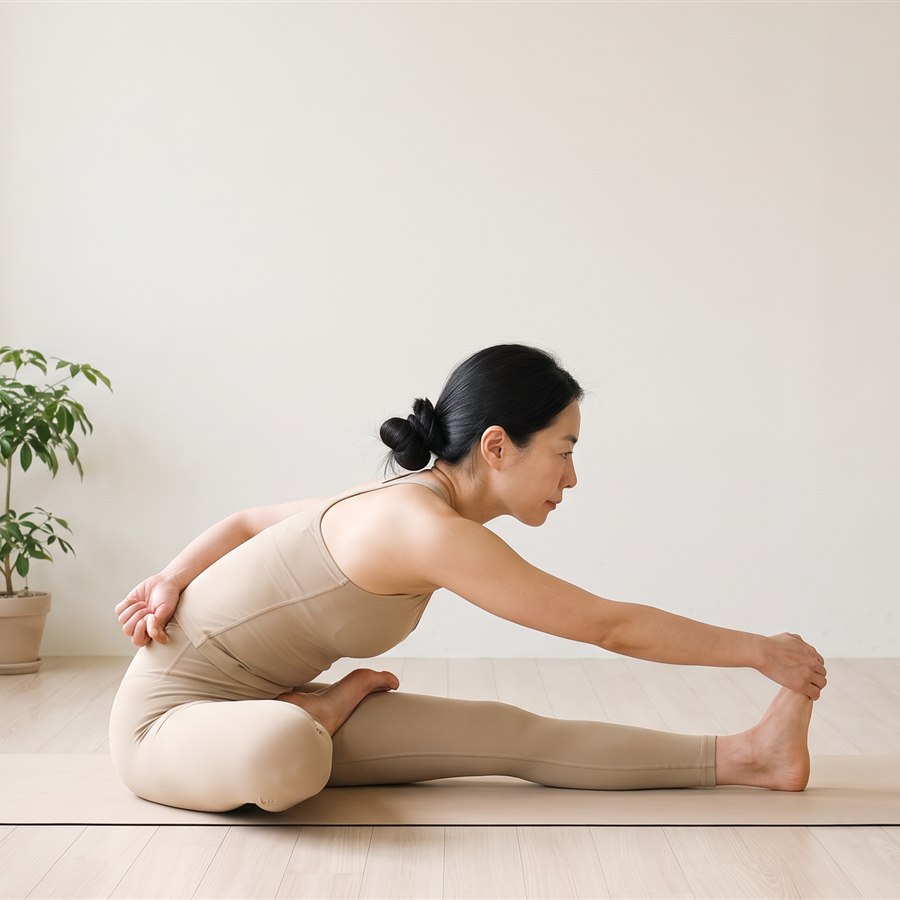
Ardha Baddha Padma Paschimottanasana - the same half-lotus leg practiced seated, where the floor supports the knee and the hip can open without balancing
When to be careful
Skip the lotus leg entirely and use the tree-pose variation if you have any current knee problem, a history of meniscus or ligament injury, or a knee that clicks painfully in rotation. Sharp or pinching sensation at the inner knee is a stop signal, not a stretch — come out immediately. Ankle injuries also deserve caution, since the lotus foot is held in a strongly turned-in position.
If your shoulder is unhappy, use the strap or drop the bind. During pregnancy, or with balance-affecting conditions, practice near a wall and keep the fold shallow. And as with every one-legged pose in this series, a hard floor and a slippery mat make balance harder than your body actually is.
🧘 Want to practice this pose right now? Open our interactive guide with photos, alignment details and a breath timer: Ashtanga Shala Practice Guide.
Take your time with this one. The standing sequence has two poses left, and both of them reward strong, patient legs rather than flexible ones. In the next post we move on to Utkatasana, chair pose — the moment the practice stops asking you to open and starts asking you to hold.
This post is general guidance, not medical advice. If you have an injury or health condition, check with a professional before practicing.

