Warrior I and II (Virabhadrasana A & B): The Finale of the Ashtanga Standing Sequence
Chair Pose asked you to sink down and stay. Warrior asks for the same patience with your feet a full stride apart, and then asks you to keep breathing while you hold it. Virabhadrasana A and B are the last two postures of the Ashtanga standing sequence — four held shapes in a row, twenty breaths of honest work — and the day you can move through all four without gritting your teeth is the day the standing sequence really belongs to you.
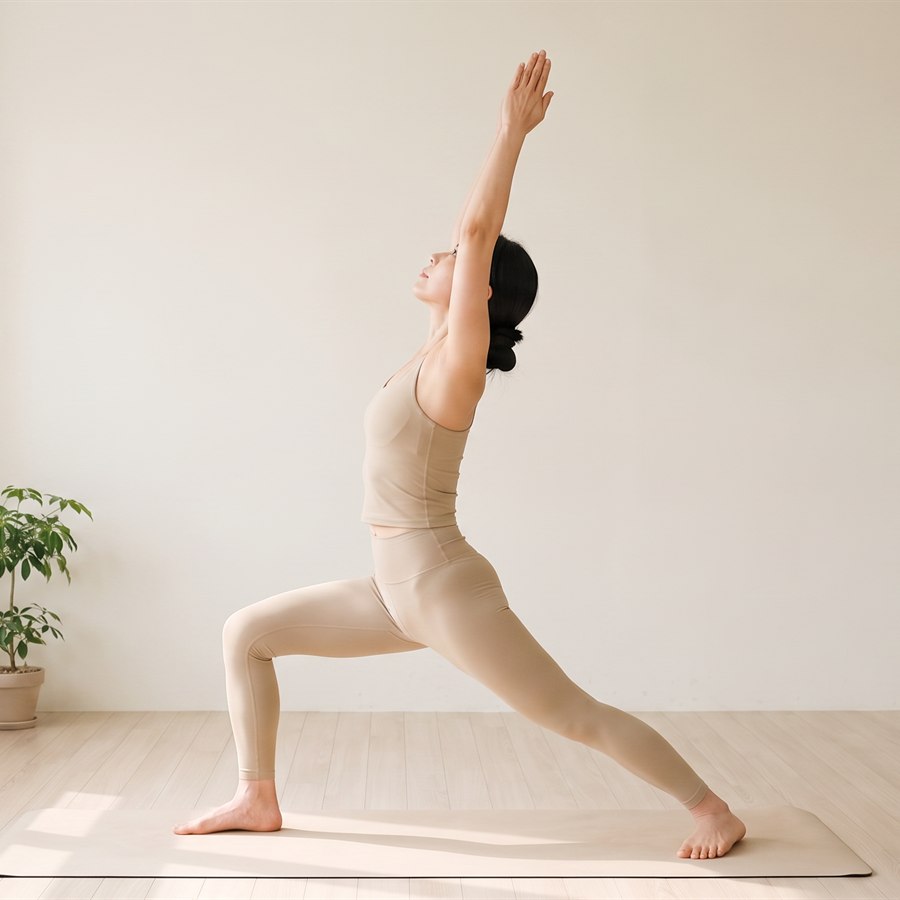
Virabhadrasana A - front knee stacked over the ankle, arms reaching straight overhead
What are Virabhadrasana A and B?
Virabhadra is a warrior from Indian myth, born out of Shiva's grief and rage. Asana simply means posture or seat, so the name is usually given in English as Warrior Pose. It is worth noticing, though, what kind of warrior the practice actually has in mind: not the one who fights hardest, but the one who can stand still inside difficulty and keep breathing evenly.
Virabhadrasana A is the upright version. The front knee bends, the hips turn toward the front of the mat, and both arms lift overhead with the palms together. Virabhadrasana B keeps the legs almost exactly where they are and opens everything above the waist out to the side, the arms stretching level with the floor in opposite directions. People who practise them regularly commonly report stronger and more patient legs, a more open chest and front hip, and — because every side is held for five full breaths — a steadier attention that tends to carry over into the rest of the practice.
You have already met Virabhadrasana A once before, inside Sun Salutation B, where it flashes past in a single breath. Here it slows right down, and the difference between passing through a shape and actually living in it becomes very clear very quickly.
Step-by-step: getting into the pose
All four sides are practised as one unbroken block: A on the right, A on the left, then B on the left, then B on the right. You do not come down in between. Begin in Downward Dog, after the vinyasa that follows Chair Pose.
- Inhaling, step your right foot forward between your hands and turn your left foot in about forty-five to sixty degrees, keeping the whole outer edge of that back foot pressed into the mat.
- On the same inhale, come all the way up: lift the torso, sweep both arms overhead, join the palms, and slide the shoulders down away from your ears even as the fingers reach.
- Bend the right knee until the shin is vertical — knee directly above the ankle, never travelling past it — and turn the hips toward the front edge of the mat as far as the grounded back heel will allow. Stay for five breaths.
- Inhaling, straighten the front leg, pivot on both heels to face the back of the mat, and bend the left knee. This is Virabhadrasana A on the left; the arms simply travel with you. Five breaths.
- Exhaling, keep that left knee exactly where it is and open: the arms sweep apart to shoulder height, palms facing down, and the torso turns to face the long side of the mat. This is Virabhadrasana B on the left. Five breaths.
- Inhaling, straighten the left leg, turn the feet and the torso to the other side, bend the right knee and settle the arms again for Virabhadrasana B on the right. Five breaths.
- Exhaling, place both hands on the floor on either side of the front foot, and take your vinyasa through to the seated sequence.
One small point about the feet in B. In Ashtanga the stance usually stays put as you open from A into B, so the back foot ends up turned in more than you may be used to from other styles. If your back hip complains, let those back toes turn out a little further. A comfortable hip is worth more than a textbook foot.
Breath and gaze (drishti)
Keep the same steady, slightly audible Ujjayi breath you have been using since Sun Salutation A. Five breaths per side sounds short and feels long, so resist the temptation to speed up when the front thigh starts to burn. If the breath turns rough or you find yourself holding it, that is the signal to come up a little, not to push harder.
In Virabhadrasana A the gaze goes up to the thumbs — urdhva drishti. If tipping your head back pinches your neck, look straight ahead instead; the drishti is there to settle the mind, not to strain it. In Virabhadrasana B the gaze travels out over the front middle finger, hastagrai drishti, which also helps keep the chest from creeping forward over the bent leg.
Common mistakes
- The front knee drifts inward. Under load, the knee tends to fall toward the big-toe side. Track it out toward the middle of the foot, and press down through the outer edge of that front foot to hold it there.
- The back heel lifts while chasing square hips. In Virabhadrasana A, most people cannot fully square the pelvis and keep the back foot down. Keep the heel; let the hip be a little open. Turning the back toes in slightly more helps.
- The ribs flare and the lower back compresses. Reaching the arms overhead often lifts the front ribs along with them. Draw the lowest ribs gently down and in, and let the arms lengthen out of a long spine rather than out of an arched one.
- Leaning over the front leg in B. It feels like more effort, but it just shifts weight off the back leg. Stack the torso over the middle of your stance, and keep the back arm reaching as strongly as the front one.
Beginner modifications
Shorten the stance first. A slightly narrower step makes a deep knee bend far more manageable and keeps the back heel on the floor, which is where most of this posture's stability lives. You can also simply bend the front knee less — go only as deep as you can hold for five breaths without the heel lifting or the breath breaking.
If joining the palms overhead pulls on tight shoulders, keep the arms shoulder-width apart with the palms facing each other. If the neck objects to looking up, keep the gaze level. And if the legs are genuinely exhausted by the fourth side, hold three breaths instead of five rather than abandoning the sequence entirely; the honest short version teaches more than the heroic collapse.
When to be careful
Go gently with a current knee or hip injury, and avoid bending deeply into a knee that is painful rather than simply working hard. If you are managing high blood pressure, or have a shoulder problem that makes overhead reaching uncomfortable, keep the arms lower or rest the hands at the heart in A. Anyone with a neck injury should keep the gaze forward rather than up. In pregnancy the wide stance is usually comfortable, but balance and fatigue change week by week, so shorten the holds as needed. As always, the pose adapts to you; you do not have to earn it by suffering.
🧘 Want to practice this pose right now? Open our interactive guide with photos, alignment details and a breath timer: Ashtanga Shala Practice Guide.
When you step your hands down after the last Warrior, the standing sequence is complete — everything from Big Toe Pose to here, all of it built on the breath you learned in the Sun Salutations. That is a real milestone, and it deserves a practice of its own. In the next post we put posts 9 through 23 together and practise the full standing sequence from start to finish, with a realistic sense of how long it takes and where to rest.
This post is general guidance, not medical advice. If you have an injury or health condition, check with a professional before practicing.


