Utthita Hasta Padangusthasana: Where Balance Stops Being About the Leg
After Parsvottanasana the standing sequence does something it has not done before: it takes a foot away. Everything until now — the folds, the triangles, the two twists — you met with both feet on the floor. Utthita Hasta Padangusthasana, extended hand-to-big-toe pose, asks you to stand on one leg and keep the same unhurried ujjayi breath you have been building since the first surya namaskara. Most people find out in the first three seconds how much of their steadiness was coming from the floor, and how little from the breath.
The lifted leg gets all the attention, but the pose is happening in the standing leg.
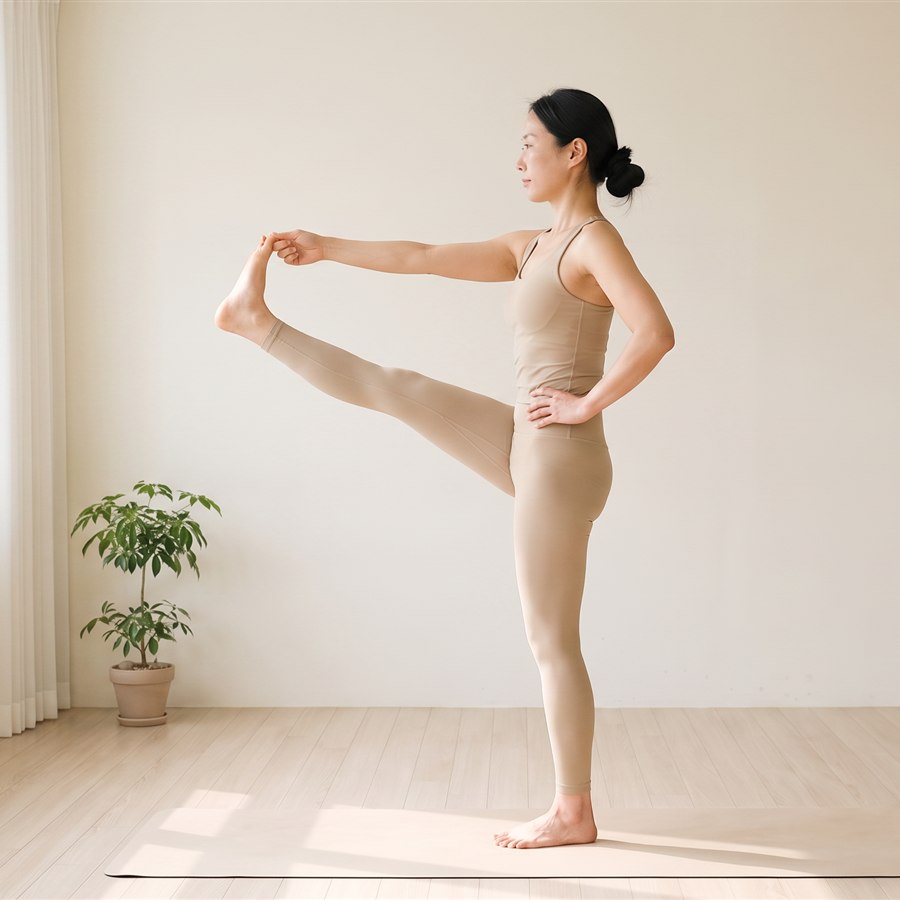
Utthita Hasta Padangusthasana A — the leg extended forward, the big toe held with the first two fingers and thumb, and the real work happening in the standing leg.
The four positions
From samasthiti you take hold of the big toe with the first two fingers and thumb — A is the leg extended straight forward, then an exhale that brings the chin toward the shin. B opens the same leg out to the side while the gaze turns over the opposite shoulder. C brings the leg back to centre and folds once more. D releases the toe altogether: hands on the waist, leg held out in front of you by nothing but your own hip.
How the breaths are distributed varies from room to room — five in each of the first positions, a shorter pause at centre, five again in D is common. The count is worth learning, but do not chase it. The shape does not change because a teacher counts differently.
What the breath is actually for
Here is the thing nobody tells you: you are not balancing with your leg, you are balancing with your exhale. When the ujjayi sound stays even and audible, the standing hip settles and the wobble becomes small and slow. The moment the breath goes silent — and it always goes silent first — the ankle starts firing and you hop.
I once worked with a student who could hold the toe with a perfectly straight leg and fell out of the pose every single morning. Nothing was wrong with her hamstrings. She was holding her breath at the top of each inhale, waiting to see whether she would stay up. I asked her to make the exhale loud enough that I could hear it from across the room and to stop caring what the leg did. She stood still that week.
Drishti helps in the same way. In A, C and D the gaze goes to the toes; in B it travels out past the shoulder, which is exactly where balance feels most fragile. Turn the head slowly, on an exhale, and let the eyes land somewhere and stay. A wandering gaze is a wandering body.
Watch out
Two places take the damage in this pose, and I know both of them from the inside.
The first is the hamstring where it attaches at the sitting bone. Pulling the extended leg up and in with the arm, especially while folding the chin toward the shin, loads that attachment hard. A sharp, thin, very specific ache right under the sitting bone is not a stretch — it is a tendon complaining, and it can take months to settle. In my early years of practice I ignored exactly that signal because the leg was going higher every week. Back off the instant you feel it. Height is not the point of this pose.
The second is the standing knee. Locking it back and hanging on the joint feels stable and is not. Keep a hair of softness behind the knee, weight spread through the whole foot rather than dropped into the heel, and let mula and uddiyana bandha carry the pelvis. If the standing hip hikes up toward your ribs, the pose has already left you.
Low back pain, a groin that pinches in the B position, or any knee that is unhappy sideways — come out. Nothing in this pose is worth an injury that costs you three months of mornings.
What I give beginners
Bend the lifted knee and hold the shin. If the toe is nowhere near, hold behind the thigh, or simply lift the knee to hip height with the hands on the waist and do only what will become D. All four positions stay exactly where they are — leg forward, leg to the side, leg to centre, hands on hips — just with a bent knee and squared hips. A bent-knee version with quiet breath is the real pose. A straight leg with a collapsed torso and a held breath is not.
Give it months, not weeks. It comes.
Stand on one leg long enough and you learn that stillness was never in the leg.


