The Full Standing Sequence (Samasthiti to Virabhadrasana B): Your First Complete Ashtanga Practice
For the last dozen posts we have taken the standing sequence apart one posture at a time. Today we put it back together. This is a checkpoint: no new pose, no new Sanskrit to memorise — just the whole standing sequence, in order, practised as one continuous thing, which is the only way it ever really teaches you anything.
If you have been reading along since Sun Salutation A, you already know every piece of what follows. What you may not have done yet is string them together in a single session and discover that the sequence has a shape of its own.
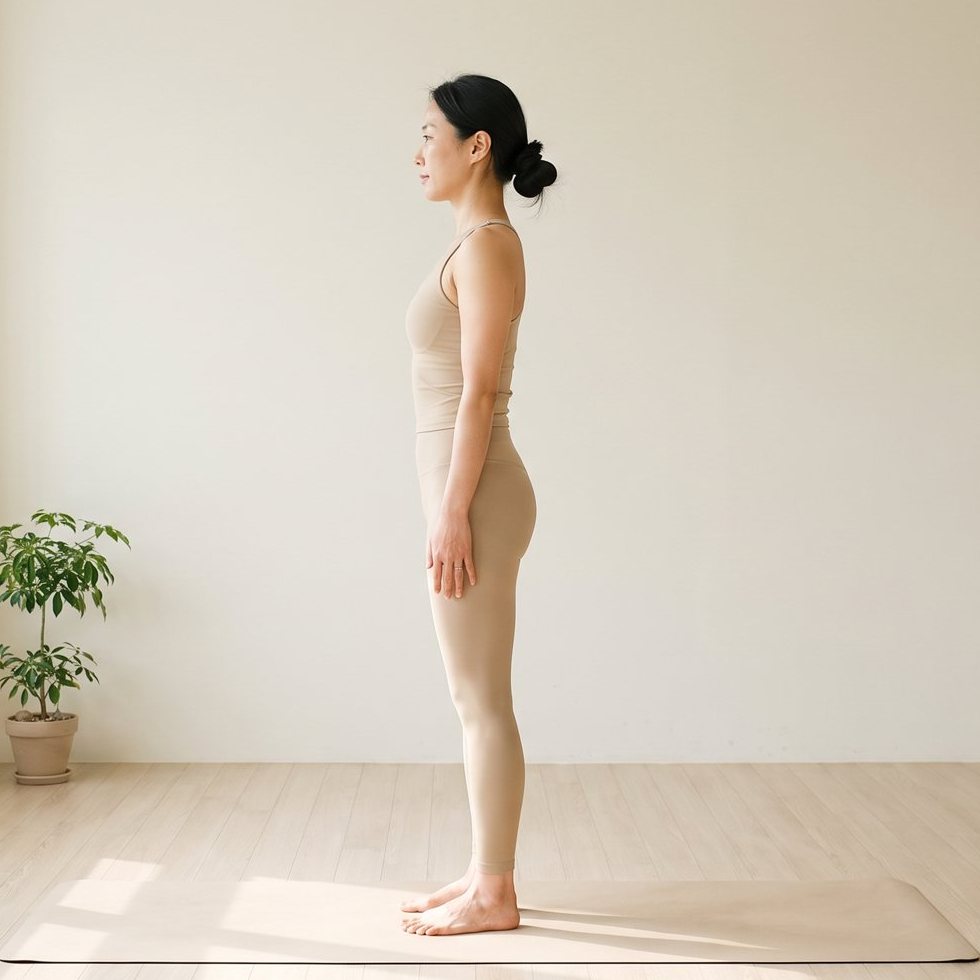
Samasthiti - feet together, arms relaxed at the sides, weight even through both heels
What a checkpoint practice is for
Learning pose by pose is efficient, but it hides something. Practised separately, each standing posture feels like a puzzle to solve. Practised in order, they stop being puzzles and become a sequence of temperatures: the sun salutations warm you, the first two folds quiet you down, the triangles wake up the sides of the body, the wide-legged folds soften the hamstrings that the triangles just worked, and the balancing and warrior postures ask for what is left of your attention.
You cannot feel that arc by doing Triangle on Tuesday and Warrior on Saturday. You feel it by starting at the top of your mat and not stopping. That is the whole point of today.
The standing sequence, in order
Here is everything, from the first breath to the last standing posture. Traditional counts are in brackets; where a pose has sides, do the right side first.
- Samasthiti — stand, settle, find the breath
- Surya Namaskara A — five rounds
- Surya Namaskara B — three to five rounds
- Padangusthasana — five breaths
- Padahastasana — five breaths
- Utthita Trikonasana — five breaths each side
- Parivrtta Trikonasana — five breaths each side
- Utthita Parsvakonasana — five breaths each side
- Parivrtta Parsvakonasana — five breaths each side
- Prasarita Padottanasana A, B, C and D — five breaths each
- Parsvottanasana — five breaths each side
- Utthita Hasta Padangusthasana — the four parts, five breaths each side
- Ardha Baddha Padmottanasana — five breaths each side
- Utkatasana — five breaths
- Virabhadrasana A — five breaths each side
- Virabhadrasana B — five breaths each side
Done at a beginner's pace, with a pause whenever you need one, that is roughly thirty-five to fifty minutes. Do not try to beat that number. The clock is not part of the practice.
How the practice actually runs
Start standing at the front of your mat, arms by your sides, and take a few quiet Ujjayi breaths before you move at all. Then begin the sun salutations. Those rounds are not a warm-up you rush through to reach the good part — they are the part that makes everything after them possible.
Inside the salutations, the transition beginners most often hurry is the return from Downward Dog to the front of the mat. Whether you step or hop, do it on an inhale, land with soft knees, and let the feet arrive between the hands rather than somewhere behind them.
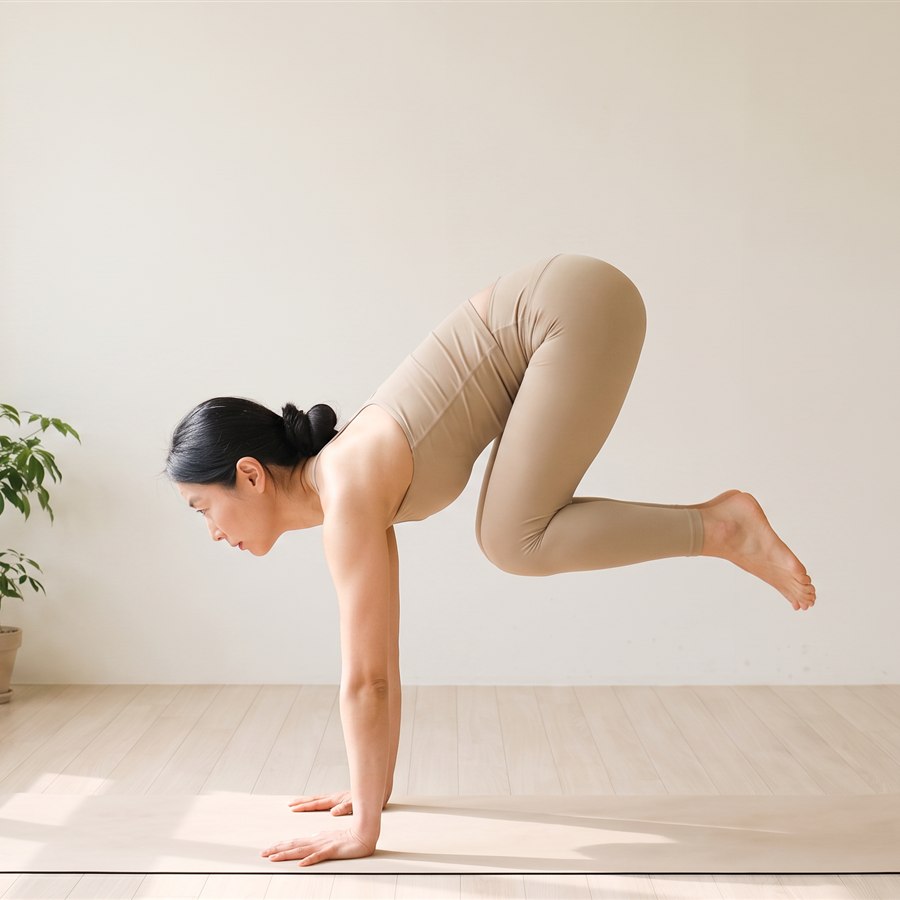
Jump Forward - feet arriving between the hands on an inhale, knees soft, gaze forward
From the end of the last salutation you stay standing. Padangusthasana and Padahastasana happen right where you are. For Trikonasana onwards you step or hop the feet apart, and between the two sides of each pose you come up through the centre — that small return to standing is what keeps the sequence from becoming a scramble.
From Utthita Hasta Padangusthasana to the end, come fully back to Samasthiti between poses. It feels like an interruption at first. It is actually the rhythm.
Breath and gaze across the whole thing
One rule carries the entire sequence: you move on a breath, and you hold for breaths. Nothing happens in silence between them. If you find yourself moving during a pause, you have lost the thread — stop, take one full Ujjayi breath, and start the next movement from there.
Gaze follows the same logic. In every standing posture the drishti is already decided: the toes in the forward folds, the top hand in the triangles and side angles, the nose in Parsvottanasana, the thumbs in Virabhadrasana A. You do not choose it in the moment. Knowing it in advance is exactly what frees your attention for the body.
Common mistakes when you string it together
- Going too hard in the first ten minutes. The sun salutations feel easy when you are fresh, so people rush them and arrive at Trikonasana already tired. Slow the first five rounds down deliberately.
- Skipping the second side. It happens more than you would think, usually in the poses you dislike. Count out loud if you must.
- Losing the breath at the hard poses. Parivrtta Parsvakonasana and the half-lotus fold are where beginners hold their breath and grimace. If the breath goes, take the modification; a poorer shape breathing well is a better practice than a good shape held in strain.
- Treating a shaky day as failure. Balance and flexibility move around from day to day for reasons that have nothing to do with effort. The sequence is the constant, not your range of motion.
How to shorten it honestly
On a day when you have twenty-five minutes, do not speed up — cut. Keep five rounds of Surya Namaskara A, three of B, then Padangusthasana, Utthita Trikonasana, Prasarita Padottanasana A, Utkatasana and Virabhadrasana A and B. That is a real practice, not a compromised one.
If tight hamstrings are the limiting factor, keep a gentle bend in the knees in every forward fold for the entire session rather than deciding pose by pose. If your shoulders complain, use the open-palm or elbow-hold variation of Prasarita Padottanasana C and Parsvottanasana throughout. Consistency in a modification is worth far more than occasional bravery.
When to be careful
If you are new to this much standing work, expect your legs to be sore for a day or two, and give yourself a rest day rather than pushing through it. Anyone with knee trouble should leave out the half-lotus in Ardha Baddha Padmottanasana entirely and stay with the modified version. If you have high or low blood pressure, come out of the deep forward folds slowly and never snap up to standing. In pregnancy, the closed twists and the deep folds are usually adapted or left out — work with a teacher who knows your situation rather than following a written sequence.
And if something hurts sharply, that is not a pose to be brave in. Come out, breathe, and move on to the next one.
🧘 Want to practice this pose right now? Open our interactive guide with photos, alignment details and a breath timer: Ashtanga Shala Practice Guide.
Try the whole standing sequence once this week, from Samasthiti to Virabhadrasana B, without stopping to look anything up. Whatever you forget is simply the post you should reread. In the next post we move on to Staff Pose (Dandasana), the seated posture from which the entire second half of the Primary Series is built.
This post is general guidance, not medical advice. If you have an injury or health condition, check with a professional before practicing.


