Staff Pose (Dandasana): The Seat Every Ashtanga Seated Posture Is Built On
After a dozen standing poses, the Ashtanga Primary Series asks you to sit down — and the first thing you sit in is Dandasana. It looks like nothing at all: legs straight, hands on the floor, back tall. But every seated posture for the next half hour borrows its alignment from this one, which is why experienced practitioners treat Dandasana as a pose to work in rather than a pause between poses.
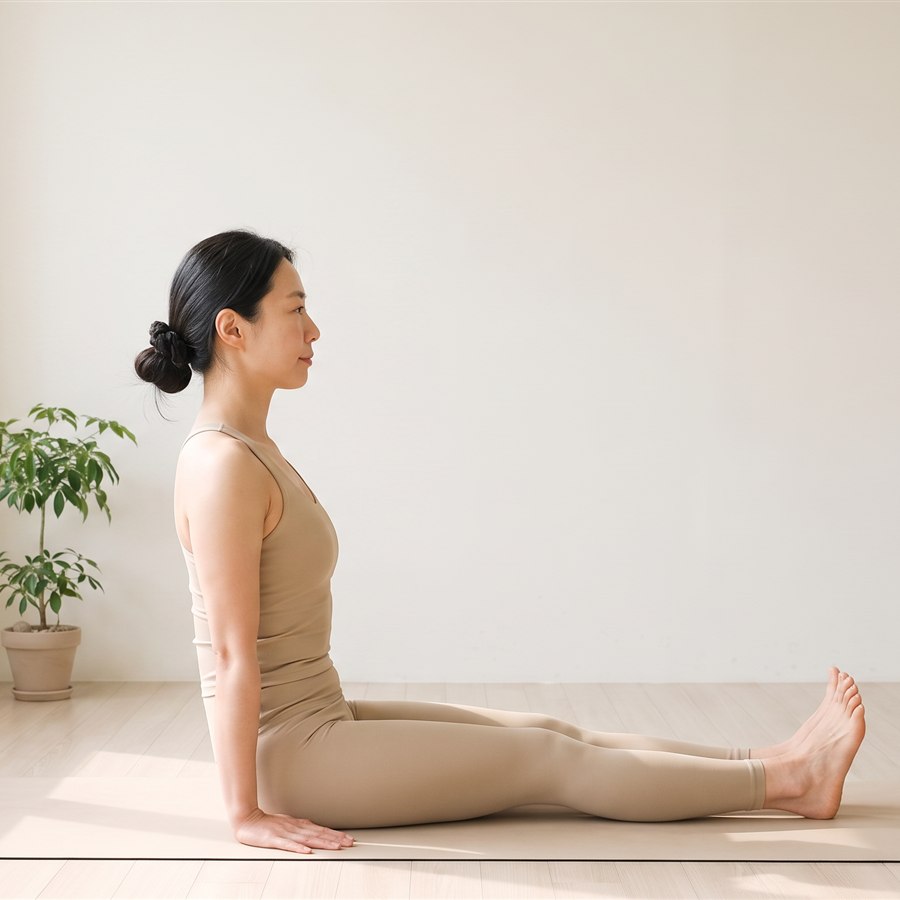
Dandasana - sitting bones rooted, legs straight and together, spine tall
What is Dandasana?
Danda means staff or stick in Sanskrit, and asana means seat or posture — so this is the pose of the staff. The staff is your spine: upright, supported, carrying the weight of your torso without collapsing into it. In the counted method, Dandasana is where the seated sequence begins, held for five breaths before you fold forward into Paschimottanasana.
What it offers is less obvious than a deep stretch, and that is exactly why beginners skim past it. Sitting with straight legs and a straight back asks the hip flexors to hold the pelvis upright, the quadriceps to keep the knees extended, and the muscles alongside the spine to stack the ribs over the pelvis. Practitioners commonly find that Dandasana shows them precisely where their sitting posture gives out. Since you return to this shape between every side of every seated pose that follows, whatever you improve here improves everything downstream.
Step-by-step: getting into the pose
- From Downward Dog, jump or step your feet between your hands and sit down with your legs extended straight in front of you. If the jump-through is not available yet, lowering the knees and walking through is a completely legitimate entry.
- Bring your legs together so the big toes, inner ankles and inner knees touch — or come as close as your hips comfortably allow.
- Flex your feet strongly: toes drawing back toward your face, heels pressing forward as though into a wall a few centimetres beyond your feet.
- Place your hands flat on the floor beside your hips, fingers pointing forward toward your feet, arms straight but not locked.
- Press down through the hands and down through the backs of the thigh bones at the same time. Feel the two sitting bones root into the mat.
- Draw the lower belly gently back and up — the same mula bandha and uddiyana bandha action described in the earlier post on the bandhas — and let that lift travel up through the spine.
- Lengthen the back of the neck, slide the shoulder blades down away from the ears, and soften the face. Hold for five breaths.
Breath and gaze (drishti)
The ujjayi breath does not change character here, but it becomes much easier to hear yourself cheat. A tall, engaged Dandasana slightly restricts the belly, so the breath moves into the ribs and back — which is exactly where you want it for the folds that follow. Keep the inhale and the exhale roughly equal in length, and resist the very common urge to take one enormous inhale, sit up beautifully for a second, and then quietly sag for the remaining four breaths.
The drishti is nasagrai, the tip of the nose, with the gaze travelling down the line of the nose toward the toes. Let the chin drop a small amount rather than tucking it hard to the chest — the neck should feel long on both sides. If lowering the gaze makes you slump, look at the toes instead and keep the chest open; a rounded back is a worse trade than an imperfect drishti.
The hands are not decoration
Beginners tend to rest their hands on the floor the way you would rest them on a table. In Ashtanga they are doing real work. Pressing the palms down lengthens the sides of the torso, lifts the ribs off the pelvis, and stops the lower back from rounding backwards — the press is what makes the pose active rather than a slouch with straight legs.
That same downward press is also the engine of the vinyasa between sides. When the practice asks you to lift up and jump back, the lift comes from the hands driving into the floor while the belly draws in, not from heaving with the shoulders. And the hand position you are learning here — beside the hips, fingers pointing toward the feet — is the same one you will move behind you for Purvattanasana, the reverse plank that arrives shortly after Paschimottanasana as the counterpose. Learning to press honestly in the simplest possible seat makes both of those far less mysterious later.
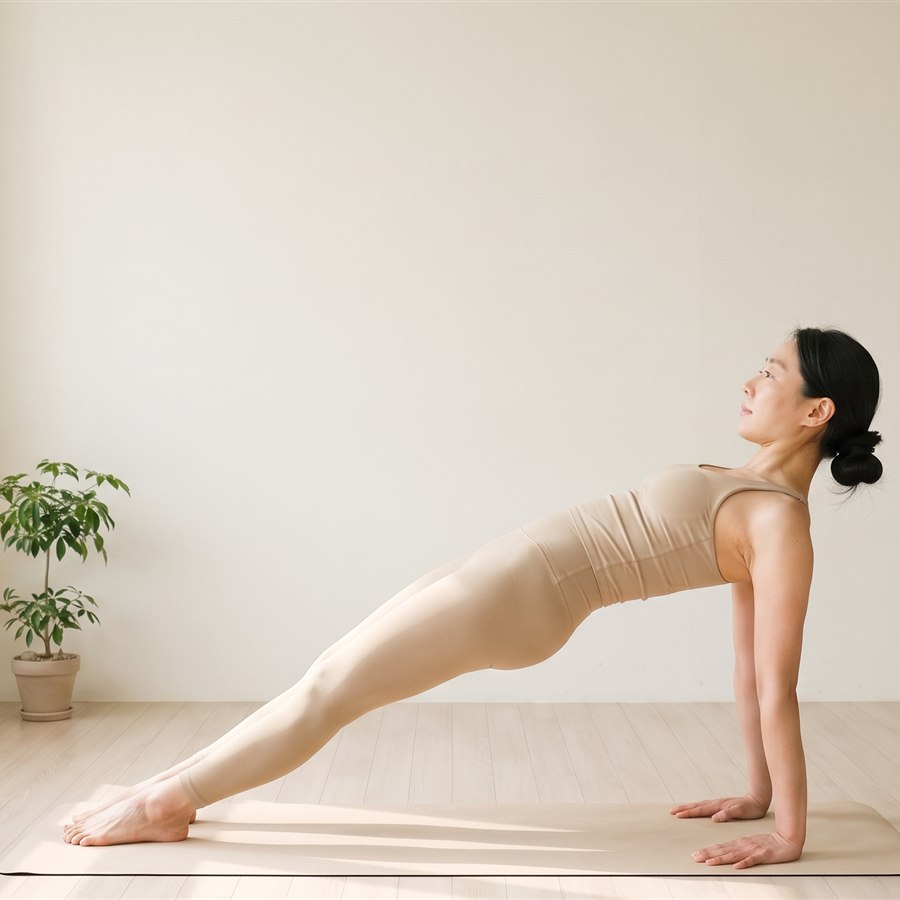
Purvattanasana - hands behind the hips with fingers pointing toward the feet, chest lifting
Common mistakes
Rolling back behind the sitting bones. Tight hamstrings pull the base of the pelvis backwards, the lower back rounds, and the chest caves. The fix is not to force the spine upright with muscle but to raise the hips: sit on the folded edge of a blanket until the pelvis can tip forward to neutral.
Jamming the knees back. Locking the knees hard, especially if your joints are naturally flexible, puts the effort into the joint instead of the muscle. Firm the quadriceps so the kneecaps draw up toward the hips, and keep a feeling of energy rather than force in the leg.
Letting the legs roll outward. Watch your feet — if the toes drift apart and the knees turn out, the inner thighs have switched off. Gently spiral the inner thighs downward toward the floor and keep the big-toe mounds pressing forward together.
Treating it as a rest stop. The pose lasts five breaths, and it is tempting to spend them recovering from the standing sequence. Keep the legs alive, keep the hands pressing, keep the breath audible. Dandasana is where you teach your body what a good seat feels like.
Beginner modifications
If your lower back rounds the moment you sit down — very common, and nothing to be embarrassed about — sit on one or two folded blankets, or the edge of a firm cushion. Height at the hips does more for this pose than any amount of effort.
If your arms feel short and your shoulders hunch up to reach the floor, place a block flat under each hand so you can press down without collapsing the chest. If the hamstrings protest, allow a small bend in the knees and keep the spine long; a tall back with soft knees is a far better Dandasana than straight legs and a rounded spine.
If sensitive wrists make the flat-palm press uncomfortable, try pressing through the fingertips instead, or turn the hands slightly outward. And if the legs simply will not stay together, let them rest a few centimetres apart and keep both feet flexing evenly — symmetry matters more than closing the gap.
When to be careful
This is a gentle posture, but a few situations deserve attention. If you have a hamstring injury, particularly near the sitting bone, sit high on a blanket and keep the knees softly bent rather than stretching into sharp sensation. With lower-back pain, the raised seat is again the first adjustment; if the pose provokes pain rather than effort, come out and check with a professional. Wrist injuries call for the fingertip or block variation rather than pushing through. In pregnancy, a wider leg position and a higher seat are usually more comfortable. As always, sensation that is sharp, electrical, or felt in a joint is a signal to stop, not to breathe through.
🧘 Want to practice this pose right now? Open our interactive guide with photos, alignment details and a breath timer: Ashtanga Shala Practice Guide.
Dandasana asks for very little and gives back a great deal, but only if you refuse to let it be a rest. Spend those five breaths pressing down through your hands, lengthening up through your spine, and noticing exactly where your body wants to give way — that information is the whole seated sequence in miniature. In the next post we move on to Paschimottanasana, the seated forward fold, where the long spine you have just built meets the first real test of the seated series.
This post is general guidance, not medical advice. If you have an injury or health condition, check with a professional before practicing.


