Seated Forward Fold (Paschimottanasana): Folding From the Hips, Not the Waist
After the long standing sequence, the practice sits down — and the first thing it asks you to do is fold. Paschimottanasana is the seated forward fold that opens the Primary Series proper, and almost every seated posture that follows borrows its logic. Learn to fold well here and the next twenty poses become far less mysterious.
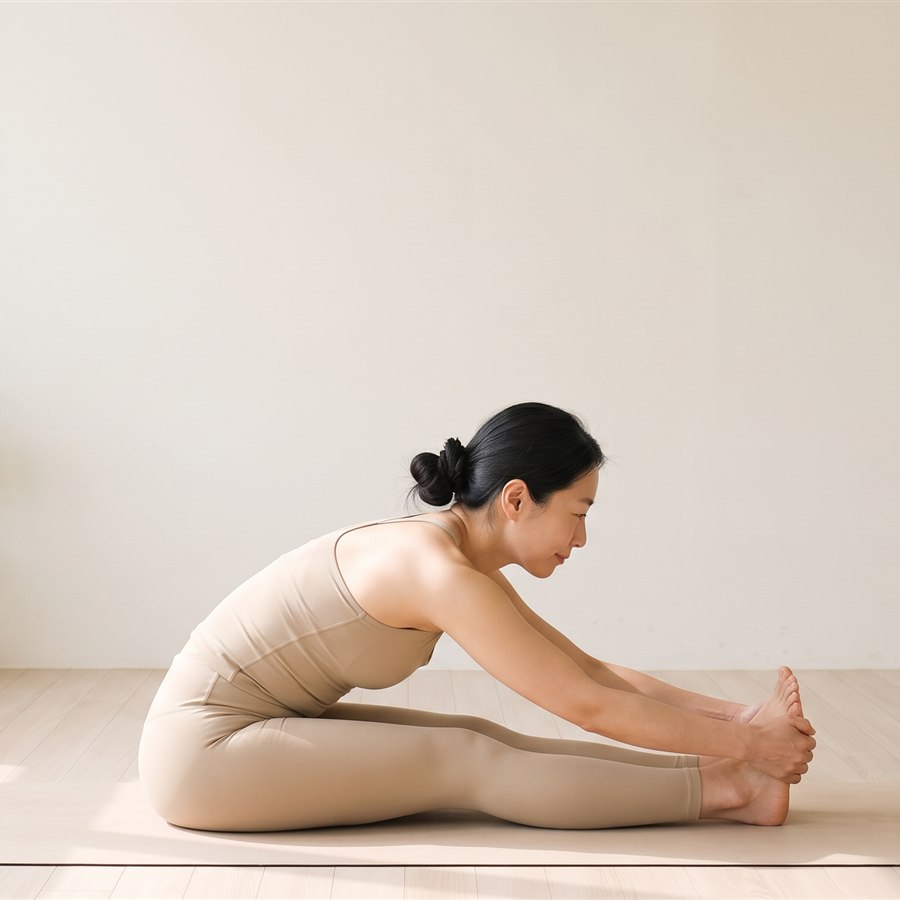
Paschimottanasana - spine long, chest reaching toward the shins rather than the head reaching toward the knees
What is Paschimottanasana?
The name breaks into three pieces. Paschima means west, uttana means intense stretch, and asana means posture — so, literally, "intense stretch of the west." In the older texts the practitioner faces the rising sun, which makes the front of the body the east side and the whole back line — calves, hamstrings, the sheet of fascia along the spine, the neck — the west. That is exactly what this pose lengthens: not the hamstrings alone, but the entire back of you, from heels to skull.
Practitioners commonly describe Paschimottanasana as the pose where the practice changes temperature. The standing sequence is bright and effortful; this one is long, quiet and internal. It is also where the Primary Series earns its other name, Yoga Chikitsa — yoga therapy. Folding forward for five slow breaths, several times over, is how the series begins to undo the compression that sitting in chairs all day builds into a spine.
Where it sits in the practice
You arrive here directly from Dandasana, the staff pose covered in the previous post. Dandasana is not a rest stop on the way — it is the shape of Paschimottanasana before you fold. If your Dandasana has a rounded lower back and collapsed chest, your forward fold will simply be that same rounded back, tipped over. So the previous post's work — sitting on the front edge of the sitting bones, legs active, chest lifted — is the entry fee for this one.
In the counted method Paschimottanasana is practised in three hand positions, five breaths each, with a full vinyasa only at the end. Most modern led classes shorten this to one or two positions. As a beginner, take one position and five honest breaths. Depth added by holding your breath is not depth.
Step-by-step: getting into the pose
- Sit in Dandasana with both legs straight out in front of you, feet together, toes pointing up toward the ceiling.
- Press the backs of the thighs down and the heels gently away, so both legs are awake rather than dumped on the floor.
- Inhale and reach both arms straight up beside your ears, lengthening the whole spine — this is the moment the pose is actually made.
- Exhale and hinge forward from the hip joints, keeping that length, reaching your hands toward your feet. Lead with the breastbone, not the forehead.
- Take the first hand position: hook each big toe with the first two fingers of the same hand, thumb on top. If the toes are out of reach, hold the shins or use a strap around the soles.
- Inhale, straighten the arms and lift the chest slightly, looking forward — the spine gets long again.
- Exhale and fold more deeply, bending the elbows out to the sides and drawing the chest toward the thighs.
- Stay for five slow Ujjayi breaths. Inhale to look up and lengthen, exhale to release the hands and come back up to a tall seat.
The second and third hand positions are the same fold with a longer grip — holding the outer edges of the feet, then clasping one wrist beyond the soles. They belong to a body that already folds comfortably. There is no prize for grabbing your wrist with a rounded spine.
Breath and gaze (drishti)
Keep the Ujjayi breath you learned in the breath post: a soft narrowing at the throat, audible to you and no one else, with inhale and exhale roughly equal in length. The pattern here is simple — every inhalation lengthens the spine, every exhalation softens you deeper into the fold. If the breath becomes short, ragged or silent, you have gone past the pose and into a wrestling match.
The drishti is padayoragrai, the toes. Let the gaze travel along the legs to the feet rather than craning the chin forward to look at them. A useful test: if your neck feels like it is working, the gaze has become a head position instead of a soft looking.
Common mistakes
- Folding from the waist instead of the hips. The spine rounds, the head drops, and the hamstrings barely feel anything. The fix: put your hands beside your hips, sit up tall, and tip your pelvis forward as if the whole torso were one board hinging at the crease of the leg. Go only as far as that board can travel.
- Pulling with the arms. Hauling on the feet drags the shoulders up around the ears and compresses the lower back. The arms are a connection, not a winch — the depth should come from the exhale and the hip hinge.
- Locking the knees hard. Jamming the knees back to prove the legs are straight can strain the joint and the hamstring attachments. Keep the thighs firm and the kneecaps lifting, but let the joint be strong rather than rigid.
- Holding the breath to go deeper. Beginners often stop breathing at the deepest point of the fold. That extra centimetre is borrowed, not earned; it disappears the moment you inhale again.
Beginner modifications
Tight hamstrings are not a character flaw, and there is nothing in this pose that a beginner must force. Three adjustments cover almost everyone:
- Sit on a folded blanket or a firm cushion. Lifting the hips two to four inches tilts the pelvis forward for you and instantly makes a long-spined fold possible. This is the single most useful change for stiff hips.
- Bend the knees. Softening the knees generously lets the pelvis rotate and the belly rest on the thighs. A folded pose with bent knees teaches the right action; a straight-legged pose with a hooped back teaches the wrong one.
- Use a strap. Loop a strap or belt around the soles of both feet and hold it with straight arms, chest lifted. You get the shape of the pose and the breath of the pose without the shoulder strain.
The same fold comes back — many times
It is worth knowing why this pose gets so much attention. The hip hinge you practise here is reused, almost unchanged, in the seated postures still to come: the one-legged folds, the head-to-knee poses, and the wide-angle seated fold, Upavistha Konasana, where the legs open but the action of the pelvis is identical. Every minute you spend learning to tip from the hips rather than crumple at the waist is repaid several times over later in the series.
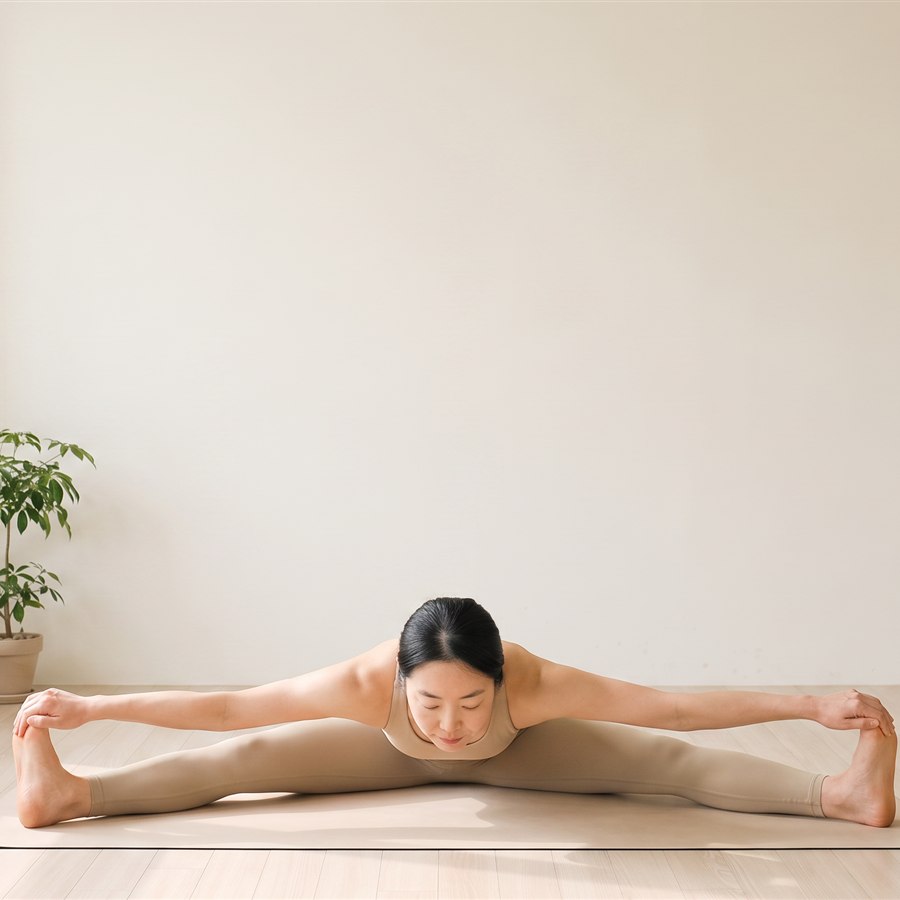
Upavistha Konasana - the same forward hinge of the pelvis, with the legs opened wide
When to be careful
If you have a disc injury, sciatica, or any lower-back condition that flares with flexion, treat deep forward folding as something to approach with a teacher rather than alone at home — keep the knees bent and the spine long, and stop well before sensation becomes sharp. A sharp or electrical feeling down the back of the leg is a signal to come out, not to breathe through. In later pregnancy, take the legs wide apart so there is room for the belly. Recent hamstring tears need patience above all; gentle, short holds with bent knees are kinder than long ones.
🧘 Want to practice this pose right now? Open our interactive guide with photos, alignment details and a breath timer: Ashtanga Shala Practice Guide.
Give this pose your patience rather than your ambition — five calm breaths with a long spine will change more in a month than a year of straining toward your toes. In the next post we move on to Purvattanasana, the reverse plank, which is the deliberate counter-pose to everything you just did: it opens the front of the body exactly where this fold closed it.
This post is general guidance, not medical advice. If you have an injury or health condition, check with a professional before practicing.


