Revolved Side Angle (Parivrtta Parsvakonasana): The Hardest Standing Twist, Made Practical
Parivrtta Parsvakonasana is the sixth and last of the standing poses that ask you to lunge, twist and balance all at once, and for most beginners it is the first posture in the Primary Series that simply does not happen on the first attempt. The arm will not reach past the thigh, the back heel lifts, the chest points at the floor instead of the ceiling. None of that is failure. It is information about where your practice is right now, and this pose is unusually good at giving it.
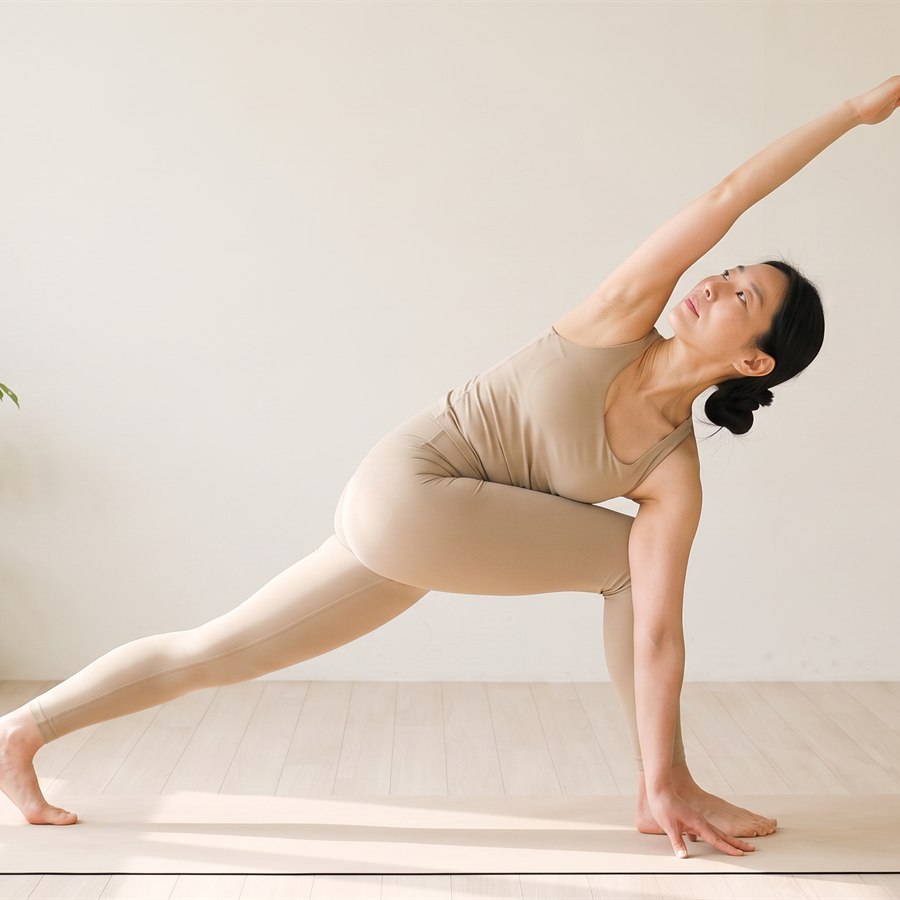
Parivrtta Parsvakonasana - back heel grounded, lower arm crossed past the front thigh, chest turning open toward the ceiling
What is Parivrtta Parsvakonasana?
The name breaks into four pieces. Parivrtta means revolved or turned around. Parsva means side or flank. Kona means angle. Asana means seat or posture. So: the revolved side-angle posture — the same shape you built yesterday in Utthita Parsvakonasana, rotated through its own axis.
It comes immediately after Extended Side Angle in the standing sequence, five breaths on each side, and it asks for three things at the same time: a deep lunge in the front leg, a long straight back leg with the heel pressed down, and a rotation of the whole torso across the front thigh. Any one of those alone is manageable. Combining them is what makes this the hardest standing pose in Primary Series for most people.
What practitioners commonly notice, after some weeks of practising it honestly, is a freer upper back, more awareness of the deep hip muscles, and a surprisingly steady head — because a twist you cannot muscle through teaches you to breathe instead of force.
Step-by-step: getting into the pose
These are the actions for the right side. The Ashtanga count links them to the breath, and the breath is what makes the pose a practice rather than a stretch.
- Inhale and step or lightly jump your feet wide apart, arms out to the sides at shoulder height, exactly as you did for the previous standing poses.
- Turn your right foot to point straight forward, ninety degrees. Turn your left foot in slightly — around fifteen to thirty degrees — so the back heel can stay down when you twist.
- Exhale and bend the right knee until the shin is vertical and the thigh is close to parallel with the floor. The knee tracks over the middle of the foot, never inside the big toe.
- Bring your palms together in front of your chest, thumbs at the breastbone. Stand tall here for one full breath before you turn — length first, rotation second.
- Exhale and turn your whole ribcage to the right, taking the left side of the chest across the right thigh. Lead with the ribs and the navel, not the head.
- Hook the left elbow beyond the outside of the right knee. If it reaches, take the left hand to the floor outside the right foot; if not, keep the palms pressed together and stay there.
- Inhale and extend the right arm over the right ear, palm facing down, so that one long line runs from the outer edge of the left foot to the fingertips of the right hand.
- Press the outer edge of the back foot firmly into the mat. This is what lets the twist deepen without the front knee collapsing inward.
- Stay for five breaths. Inhale to unwind and come up, then repeat everything on the left side for five breaths.
Breath and gaze (drishti)
The traditional drishti is hastagrai — the fingertips of the raised, upper hand. Turning the gaze up under the arm completes the spiral through the neck and gives the pose its balance challenge.
If looking up makes your neck ache, pinches, or makes you wobble so much that you hold your breath, look straight out to the side or down at the floor instead. A steady breath outranks a traditional gaze every single time.
Keep the ujjayi sound going, and let the two halves of the breath do different jobs: each inhale lengthens the spine a little, each exhale rotates a little further. If the sound of your breath disappears, you have gone past your working edge — back off until you can hear yourself again. If you are new to that soft ocean sound at the back of the throat, the earlier post on Ujjayi breath is worth rereading before you attempt this pose.
Common mistakes
- Twisting from the neck first. The head turns easily, so it goes first and the ribs never follow. Fix: turn the ribs and belly button first with the palms still together at the chest, and let the head be the last thing that moves.
- Letting the back heel lift. Once the heel comes up, the back leg stops supporting you and the pose becomes a balancing trick on the front foot. Fix: shorten your stance by a few inches and turn the back foot in a little more, then plant the outer heel before you rotate.
- Prying with the elbow. Shoving the arm past the knee collapses the chest toward the floor and rounds the upper back, which is the opposite of what a twist wants. Fix: press the arm and the leg against each other, then use that pressure to lift and open the chest rather than to dig deeper.
- Front knee drifting inward. Under the load of a twist the knee wants to fall toward the midline. Fix: press through the ball of the big toe and actively spin the front knee outward toward the little-toe side of the foot.
Beginner modifications
Almost everyone should practise one of these for the first months, and there is no shame in any of them. A modified pose done with a full breath is worth more than a full pose done while holding your breath.
- The lunge version. Lower the back knee to the mat and let the back foot rest on its toes. This removes the balance problem completely and lets you learn the rotation on its own. This is the version most beginners should live in.
- Prayer twist. Keep the palms together at the chest and simply hook the elbow past the outside of the front knee. No floor contact, no raised arm.
- Hand on a block, or on the shin. If the lower hand almost reaches the floor, put a block outside the front foot and press into that instead. A hand on the front shin also works.
- Hand inside the front foot. Placing the lower hand inside rather than outside the foot makes the twist significantly shallower and is a friendly place to start.
Where this twist is going
The lever you are learning here — one limb pressing against the opposite thigh to rotate the spine — comes back later in the seated sequence, most famously in Marichyasana C. If revolved side angle feels impossible today, it is worth knowing that the standing twists are the training ground for those seated ones, and that time spent here is never wasted.
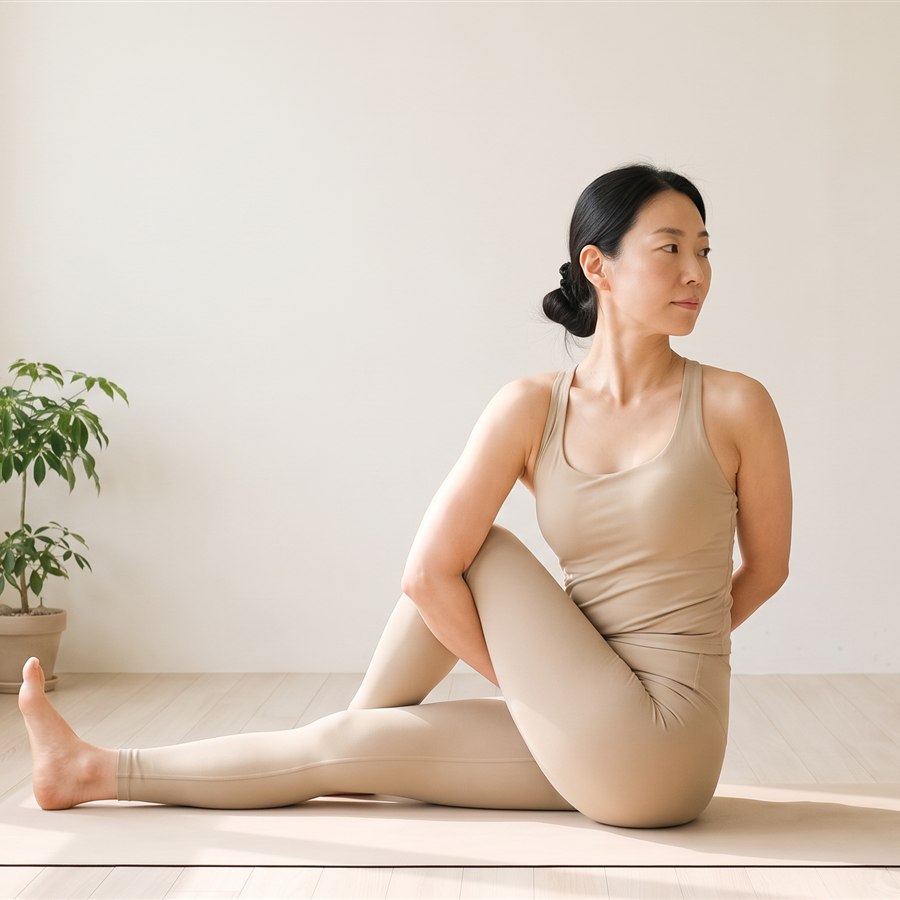
Marichyasana C - the same opposite-arm-to-opposite-thigh lever, practised seated
When to be careful
Deep closed twists are generally not recommended during pregnancy; open twists or the lunge version with no rotation across the belly are the usual alternatives. If you have a disc injury, sacroiliac pain, or a history of low-back problems, work only in the lunge version and stop well before any pinching sensation. Knee injuries mean watching the front knee alignment carefully and shortening the stance. If you have uncontrolled high or low blood pressure, skip the raised arm and the upward gaze, and come out slowly.
🧘 Want to practice this pose right now? Open our interactive guide with photos, alignment details and a breath timer: Ashtanga Shala Practice Guide.
Tomorrow we move on to Prasarita Padottanasana A and B, the wide-legged forward folds — after six poses of lunging and twisting, the practice finally lets your legs stay straight and your head hang heavy. Practise the lunge version tonight, breathe five real breaths on each side, and let the full pose arrive in its own time.
This post is general guidance, not medical advice. If you have an injury or health condition, check with a professional before practicing.


