Half-Bound Lotus Forward Fold (Ardha Baddha Padma Paschimottanasana): When to Skip the Lotus
The seated sequence has taught you three things so far: how to sit honestly in Dandasana, how to fold from the hips in Paschimottanasana, and how to undo that fold in Purvattanasana. The fourth seated posture asks for something genuinely new. Ardha Baddha Padma Paschimottanasana puts one foot into half lotus, folds you over the other leg, and sends one arm behind your back to catch that lotus foot. It is also the first posture in the Primary Series where the honest answer for a lot of beginners is "not yet" — and knowing that is part of learning it.
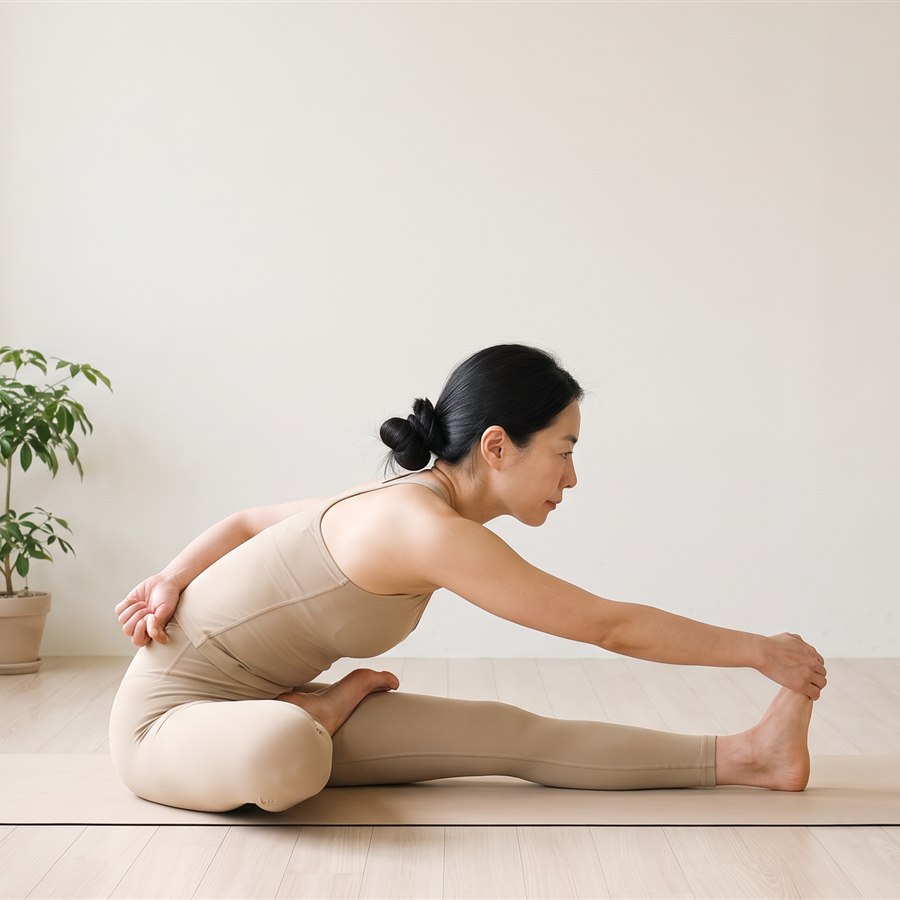
Ardha Baddha Padma Paschimottanasana - right foot high in the left hip crease, right hand binding behind the back
What the name is telling you
Ardha means half. Baddha means bound. Padma means lotus. Paschimottanasana is the intense stretch of the west — the whole back body, from heels to the base of the skull. Put together: the half-bound-lotus intense western stretch. Every word in the name is a piece of the instruction, which is typical of Sanskrit pose names and a good reason to learn them rather than skim past them.
Three separate things happen at once here. One hip rotates outward deeply enough to lift a foot onto the opposite thigh. The other leg stays straight while you fold over it. And the binding shoulder rotates inward and back. Practitioners commonly report that the posture feels far harder than any of those three actions on its own, and that is exactly why: you are asking for all of them in the same breath.
Before you try it: the hip test
The knee is a hinge. It bends and straightens well, and it rotates very little. Half lotus asks for rotation, and if the hip will not supply it, the knee gets asked instead — which is how people end up with a sore inner knee that takes months to settle. So before your foot goes anywhere near your thigh, check where the rotation is coming from.
Sit down, bring the soles of your feet together and let your knees release toward the floor without pushing them. This is the shape of Baddha Konasana, which arrives much later in the series, but it makes an excellent honest test right now.
If your knees float high and your groin feels gripped and defensive, your hips are not yet ready to rotate a foot up into half lotus. That is information, not failure. Use the modification below and come back to the full shape in a few months. If your knees settle reasonably low and the sensation is a broad stretch in the inner thigh rather than a sharp line at the knee joint, you can try the lotus foot — carefully.
Step by step
The right side is always taken first, held for five breaths, followed by a vinyasa, then the left.
- Sit in Dandasana: both legs straight and active, hands beside the hips, spine tall, the crown lifting.
- Bend the right knee and cradle the right shin in both arms. Draw it toward your chest and rock it gently side to side. This opens the hip before you place anything, which is the whole point.
- Rotate from the hip and set the outer edge of the right foot high in the left hip crease — as close to the hip as it will go. The sole faces up and the heel points toward your navel. If the foot slides down toward the knee, it is not ready.
- Let the right knee lower toward the floor on its own. Do not press it down with your hand.
- Inhale, reach the right arm behind your back, around the waist, and hook the right big toe with your first two fingers and thumb. If the toe is nowhere near, use a strap or the non-binding version below.
- Inhale and reach the left hand forward to take the left foot — the outer edge, the big toe, or the shin. Take whatever you can reach with a long spine.
- Exhale and fold forward over the straight left leg, chin travelling toward the shin, elbows softening out to the sides.
- Stay five full breaths. Inhale and look up, lengthening. Exhale, release, and take your vinyasa before the second side.
Breath and gaze (drishti)
Keep the same steady Ujjayi breath you built in the earlier standing postures: a soft, audible whisper at the back of the throat, inhale and exhale roughly even in length. The bind narrows one side of your ribcage, so the breath will feel slightly lopsided. That is normal. What is not normal is holding your breath while you hunt for the toe behind your back — if you cannot breathe in the shape, the shape is currently too much for you.
The drishti is nasagrai, the tip of the nose. As you fold, the gaze falls naturally along the nose toward the straight leg. Keep the neck long rather than craning to look at your foot.
Common mistakes
- Placing the lotus foot too low, near the knee. A foot resting on or below the knee levers the joint sideways every time you fold. Fix: the foot goes high in the hip crease or it does not go in lotus at all today.
- Twisting the torso to win the bind. Many people rotate the chest toward the bound side to make the fingers reach the toe, and lose the forward fold entirely. Fix: keep your chest square to the straight leg. If the bind costs you the square, drop the bind.
- Letting the straight leg roll outward. The left foot flops open, the kneecap turns out, and the hamstring stretch disappears. Fix: flex that foot so the toes point up, press the back of the thigh toward the mat, and keep the kneecap facing the ceiling.
- Rounding from the waist to get lower. The same habit the Paschimottanasana post warned about shows up again here. Fix: hinge at the hip crease and lead with the sternum. A shorter fold with a long spine is worth more than a deep one with a rounded back.
Beginner modifications
Strap the bind. Loop a strap around the lotus foot, pass it behind your back, and hold it with the binding hand. You get the same shoulder work without wrenching the shoulder to reach a toe that is out of range.
Skip the lotus, keep the pose. Instead of lifting the foot onto the thigh, place the sole of the bent leg against the inner thigh or calf of the straight leg, knee out to the side. Then fold forward with both hands toward the straight foot. This is very close to Janu Sirsasana, which arrives a few postures later in the seated sequence, and it keeps the fold, the hamstring stretch and the hip rotation while asking nothing of the knee.
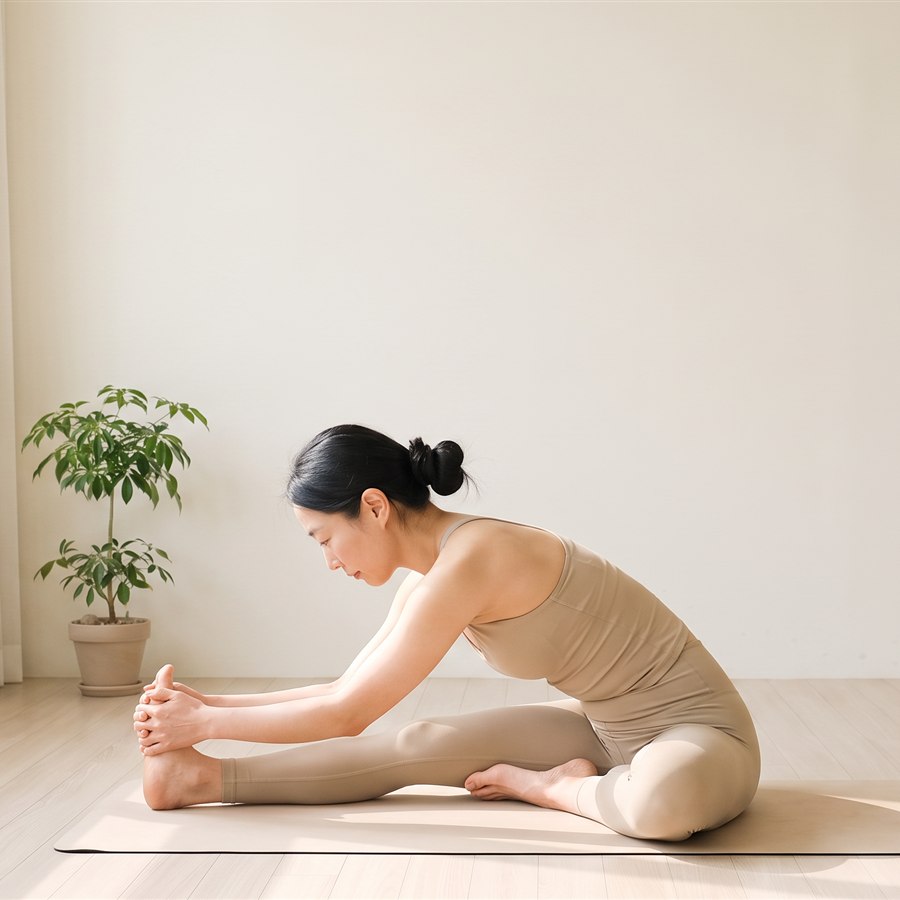
Janu Sirsasana - bent-leg sole against the inner thigh, chest folding over the straight leg
Practise that version for as long as it takes. Nobody watching your practice can tell whether your hip opened this month or next year, and the knee you protect now is the one that will still be with you in ten years.
Sit on height. A folded blanket under the sitting bones tips the pelvis forward and makes the fold available without forcing the lower back to round. If you found this helpful in Paschimottanasana, it helps here too.
Bend the straight knee slightly. Tight hamstrings will pull the pelvis backward and round your spine. A small bend in the straight knee lets you fold from the hip instead.
You met the same foot placement standing up in Ardha Baddha Padmottanasana earlier in the series, and the rules have not changed: the hip supplies the rotation, and the knee gets a vote.
When to be careful
Any history of knee trouble — meniscus tears, ligament injuries, a replacement — means skipping lotus entirely and using the non-lotus version above. This is not a temporary caution; it is a permanent, sensible choice, and plenty of long-term practitioners make it.
Deep hip rotation is also worth avoiding if you have had hip surgery or a labral injury. If you are pregnant, take the straight leg wider, skip the bind, and do not compress the belly. A shoulder injury means holding the shin or using a strap rather than binding. And as always, sharp or pinching pain anywhere is a signal to come out, not a sensation to breathe through.
Give this posture a few months rather than a few days. The hips open slowly, and the version you can breathe in today is the one that will get you to the full shape eventually.
🧘 Want to practice this pose right now? Open our interactive guide with photos, alignment details and a breath timer: Ashtanga Shala Practice Guide.
In the next post we move on to Triang Mukha Eka Pada Paschimottanasana, the three-limbed forward fold, where the bent leg folds backward instead of inward — and the honest conversation shifts from your knee to your ankle and your sitting bones.
This post is general guidance, not medical advice. If you have an injury or health condition, check with a professional before practicing.


