Chair Pose (Utkatasana): Weight in the Heels, Knees Behind the Toes
Every pose in the standing sequence so far has asked you to lengthen, fold, twist or balance. Utkatasana asks for none of those. It asks you to stay. Feet together, knees deeply bent, arms overhead, gaze to the thumbs — and then simply remain there for five breaths while the thighs begin to burn. It is the first pose in the Ashtanga Primary Series where nothing is being stretched open and everything is being asked to hold.
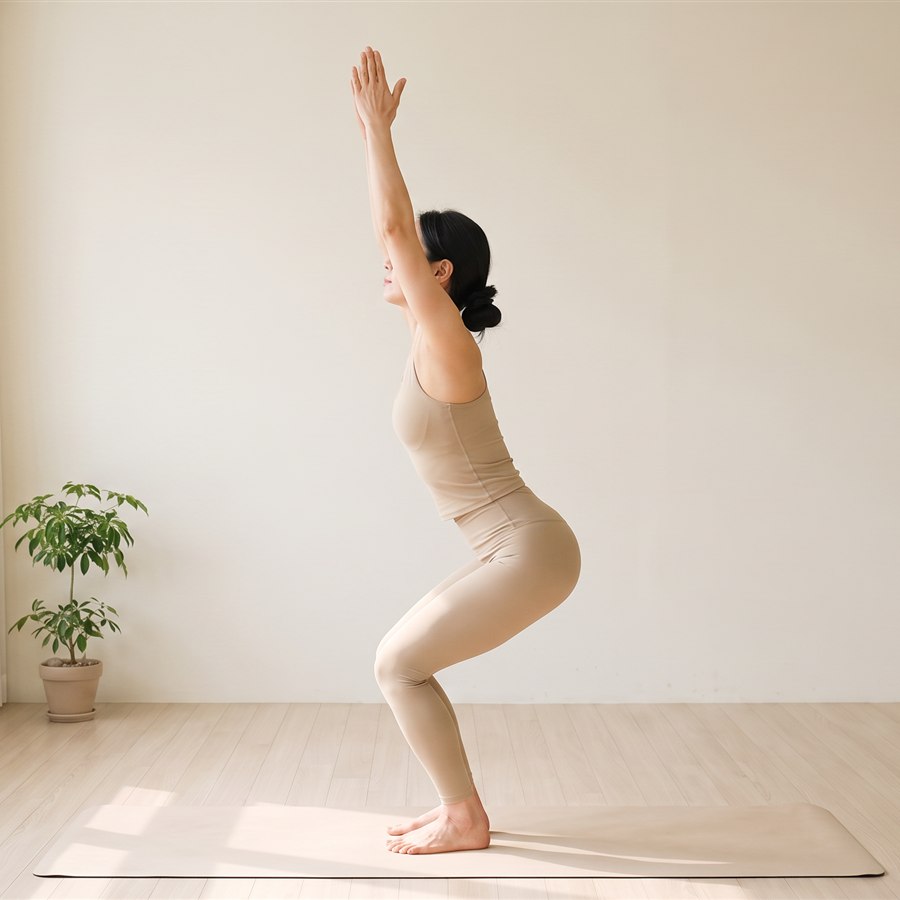
Utkatasana - big toes and heels together, weight settled back into the heels, palms joined overhead, gaze up to the thumbs
The name is not "chair"
Everyone learns this pose as chair pose, and the nickname does it a disservice. Utkata means fierce, intense, powerful — something closer to violent than to furniture. The Sanskrit is not describing a person sitting comfortably. It is describing held fire.
I mention this because the name shapes how people practise. A student who thinks "chair" sinks down and waits for it to be over. A student who hears "fierce" understands that the burning in the thighs is not a failure of the pose but the entire content of it. Nothing here is going to become comfortable. The work is to keep the breath even while it is not.
You have already done this pose five times this morning
Here is something beginners rarely notice. Utkatasana is not new. It is the opening movement of Surya Namaskara B — the shape you rise into from samasthiti before the first forward fold, and again on every round. If you practise five B salutations, you have already passed through this exact position ten times before you meet it formally in the standing sequence.
That is why it belongs here. The Sun Salutations show you a shape in motion; the standing sequence stops the motion and makes you live inside it. In Surya B you are in Utkatasana for one breath and then you move on. Here you get five, and five is a very different number.
The vinyasa, and where the breath goes
The entry is one continuous movement, and it is an inhale. From the forward fold, you inhale and rise, and as you rise the knees bend and the arms sweep out and up until the palms meet overhead. Rising, bending and reaching are not three actions in sequence — they are one action, and one breath carries all of it.
Then you hold for five breaths. Not five fast breaths taken to get through it, and not five heroic long ones either. The same steady ujjayi you have been making since the opening chant: the soft ocean sound at the back of the throat, inhale and exhale the same length. This is the honest examination of the pose. Your thighs are burning and your breath does not know it. If the breath shortens, tightens, or catches — if it starts to sound like effort — you are deeper than you can currently hold, and you should come up an inch.
The drishti is the thumbs, angusta ma dyai. The head tips back a little to find them, which is exactly why the neck needs attention here rather than enthusiasm. More on that below.
The exit is the part nobody warns you about. On an exhale the hands plant on the floor, and then the whole body lifts and jumps back to chaturanga. Lifting off from a deep squat with the feet together is genuinely one of the trickiest transitions in the Primary Series, and it is completely reasonable to spend a long time simply stepping back instead. The pose is not graded on the exit.
Three adjustments, and one test that checks all of them
Whatever else is happening, three things make this pose safe and effective:
- Weight into the heels. The sit goes back, not down.
- Tailbone gently dropped. Not tucked hard — just enough to stop the lower back from arching.
- Ribs drawn in. Reaching the arms overhead tempts the front ribs to flare open; the uddiyana bandha you have been building keeps them home.
Now the useful part. There is a single test that tells you whether all three are true: try to lift your toes off the floor. If the toes rise easily, your weight is where it belongs and your knees are protected. If they will not budge, the weight has drifted forward into the front of the foot, the knees are travelling past the toes, and the lower back is almost certainly arching to compensate.
I give this test to every student who tells me their knees ache in Utkatasana, and it solves it more often than any instruction about depth. Depth is a question for later. Weight in the heels is a question for today.
Watch out
The knees. The rule is simple and non-negotiable: the knees stay behind the toes. A knee that travels forward over the foot in a loaded bend puts shear through the joint that it is not built to absorb. If you cannot sit deep and keep the knees back at the same time, sit less deep. Always.
The lower back. A pinching, compressed feeling low in the spine means the pelvis has tipped and the arch has taken over the work the legs should be doing. Come up until the waist feels long again. Depth extends only as far as length allows — that is true here and it stays true for the rest of the practice.
The neck. Looking up to the thumbs should be a soft lengthening of the back of the neck, not a crunch. If you feel compression at the base of the skull, or you have any neck history at all, look straight ahead instead. A drishti is a tool for steadying the mind, and a drishti that hurts is not doing its job.
The shoulders. Palms joined overhead with straight elbows is not available to every shoulder yet, and forcing it simply lifts the ribs and hollows the back. Which brings us to the modifications.
If the full shape is not there yet
None of these are failures. Each is a version of the pose that lets the legs do their work honestly.
- Tight shoulders: keep the palms joined at the chest and let only the legs work. The arms can join later; the pose is in the thighs.
- Lower back complains: sit higher. A shallow Utkatasana with a long waist is a far better pose than a deep one that is really a backbend.
- Heels unsteady or feet together feels impossible: take a fist-width between the feet. It is a small and honest departure from tradition, and it is much better than practising for months on wobbling heels.
Why the sequence puts it here
Utkatasana marks a turn. Everything before it in the standing sequence has been about opening — lengthening hamstrings, rotating the spine, folding. From here to the end, the standing poses are about holding and building, and this is where that begins. The heat and the raised heart rate you generate in these five breaths carry directly into both Virabhadrasanas, and from there into the vinyasa that crosses over into the seated poses.
So it is not a rest and it is not a filler. It is where the practice changes its mind about what it wants from you.
The thighs will burn. Let them. Just do not let the breath find out.


