Vinyasa: Why Every Movement Has a Count
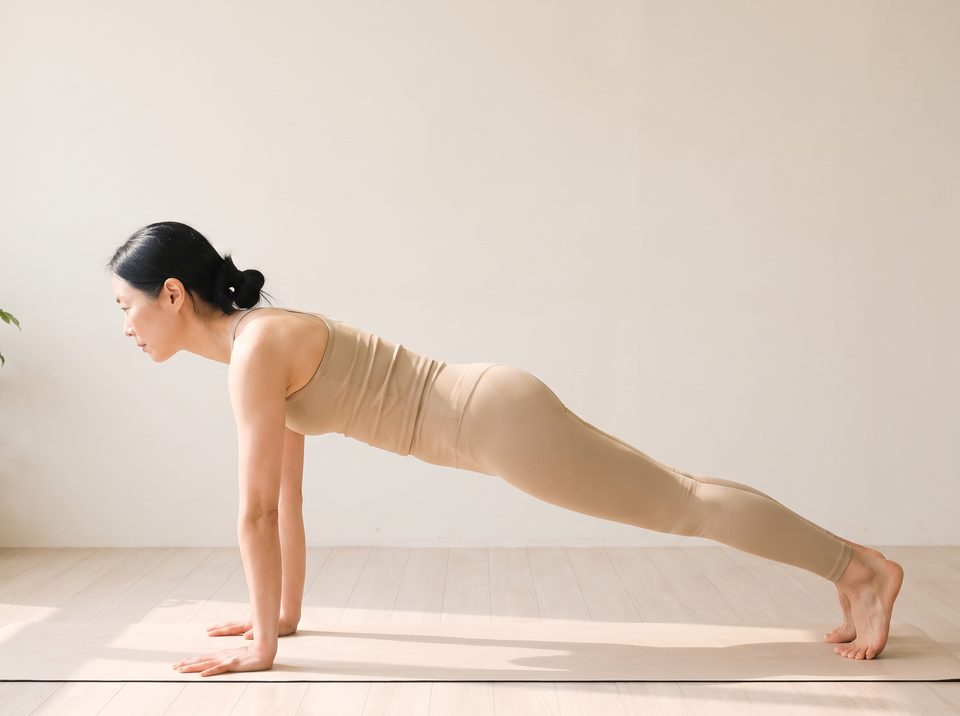
Vinyasa — one breath, one movement, in a fixed and counted order
So far in this series we've built the invisible toolkit of Ashtanga: the Ujjayi breath, the bandhas, and drishti. Today we meet the system that ties them all together and gives Ashtanga its unmistakable rhythm: vinyasa, the rule that every movement in the practice is linked to a breath — and every breath has a number. Of everything I have absorbed in my years on the mat, this counted structure is what I would keep if I could keep only one thing.
What does vinyasa mean?
Vinyasa is usually translated as "to place in a special way." In the Ashtanga method it means something quite precise: each posture is entered and exited through a fixed series of movements, and each of those movements is assigned to either an inhale or an exhale. Nothing is improvised. When you step your feet apart, that happens on a breath. When you fold forward, that happens on a breath. When you jump back and roll through to face the sky, every stage of that journey has its own count.
Teachers in a led Ashtanga class count these movements out loud in Sanskrit — ekam (one), dve (two), trini (three), and so on. The count is not decoration. It is the choreography itself: a shared metronome that tells you exactly what your body and your breath should be doing at every moment of the practice. I have stood in led classes where none of us shared a spoken language with the teacher or each other, and yet a whole room inhaled on ekam and rose as one body. That is what a century of counting builds: a practice you can carry into any room in the world and find yourself already fluent.
Why count movements at all?
To a newcomer the counting can seem fussy, even rigid. I resisted it myself in my first years — I wanted to linger where I was comfortable and hurry where I was not. There are three honest answers to why the count won me over completely.
The count keeps the breath in charge. Without a fixed structure, most of us move at the speed of our thoughts — rushing what we dislike, lingering on what feels good. The count removes that negotiation. One breath, one movement, in a fixed order: the breath sets the pace, and the body follows. This is what practitioners mean when they say Ashtanga is a moving meditation. The counting silences the constant "what next?" so attention can rest on the breath itself.
The count makes the practice repeatable. Because every practitioner moves through the same sequence on the same breaths, your practice today can be compared honestly with your practice last month. The sequence never changes, so you can see clearly how you have changed. That steady mirror is one of Ashtanga's greatest gifts — and, some mornings, its least comfortable one.
The count builds heat evenly. Continuous breath-linked movement warms the body gradually and keeps it warm, so that by the time you reach the deeper postures, your muscles are genuinely ready for them. The vinyasa between poses is not filler between the "real" postures — it is what makes the postures safe.
How the breath maps to movement
The mapping follows a simple and beautiful logic that you will feel in your own body within a week of practicing:
- Inhales go with movements that lift, open, or lengthen the body — reaching the arms overhead, lifting the chest into upward dog, rising to stand.
- Exhales go with movements that fold, twist, or ground the body — folding forward, moving into downward dog, lowering down.
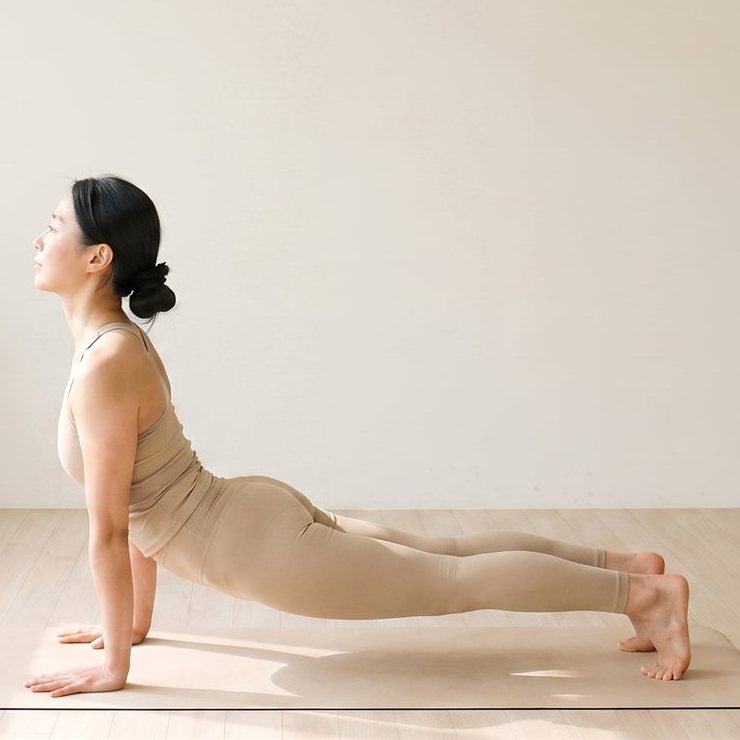
Upward-Facing Dog — the chest opens on the inhale, riding the breath upward
Try it right now, sitting wherever you are: inhale and reach your arms overhead, exhale and fold gently forward over your legs. Notice how natural that pairing feels — and how strange the reverse would feel. Ashtanga simply takes this instinct and applies it consistently to every movement in the practice, with your audible Ujjayi breath as the soundtrack. The ocean-sound of the breath should stay smooth straight through each transition — if the sound survives the movement, the movement was honest.
One practical note: the breath leads by a fraction of a moment. You begin the inhale, and then the arms rise, riding on it. If you find yourself finishing a movement and then waiting for the breath to catch up, slow the movement down rather than shortening the breath. The breath is the master; the body is the student. It took me an embarrassing number of years to stop reversing those roles.
About the jump-through (a myth worth debunking)
Watch any video of an experienced Ashtanga practitioner and you'll see it: the graceful jump from downward dog straight through the arms into sitting, feet never touching the floor. Beginners often assume this is a requirement — and some quietly conclude that Ashtanga "isn't for them" because it looks impossible.
Let's put that to rest. The jump-through is not an entry requirement; it is a side effect of years of practice. I spent my own early years stepping through one foot at a time, and then more years landing in an ungraceful heap — and my practice counted just as much. Every experienced practitioner you admire has the same history, whatever their videos suggest. What matters in the vinyasa system is that you keep moving with the breath — how athletically you travel between poses matters far less than when. Step through on the same breath the jump would happen on, and you are doing the method correctly, full stop.
Common mistakes
Holding the breath during transitions. The hardest moments — lowering from plank, stepping through — are exactly where beginners freeze the breath. If a transition takes you longer than one breath at first, breathe extra breaths as needed and rejoin the count. A moving breath always beats a held one.
Racing the count. Some days the body wants to sprint through the sequence to get to the end. Resist it. If your breath is getting short and quiet, you are moving faster than your breath — the one thing the method asks you not to do.
Treating transitions as rest. The opposite error: going vague and floppy between poses. The vinyasa keeps gentle engagement — the bandhas we met earlier stay softly active — so the body stays warm and protected all the way through.
Trying to memorize every count before practicing. You don't need to know that a posture's entry is sapta (seven) to practice it well. The counts will sink in naturally over months of practice. Start by pairing breath with movement; the numbers come later.
A simple exercise to feel it
You can experience the counted method today with nothing but a chair or a patch of floor. Set a timer for three minutes. Inhale, reach both arms overhead; exhale, fold forward; inhale, lift halfway with a long spine; exhale, fold again; inhale, rise all the way and reach up; exhale, lower the arms. That's six movements, six breaths — a miniature vinyasa. Repeat it slowly, with the Ujjayi sound smooth and even the whole way through. If your mind stayed with the breath for even half of it, you have felt exactly what the full practice cultivates.
Watch out
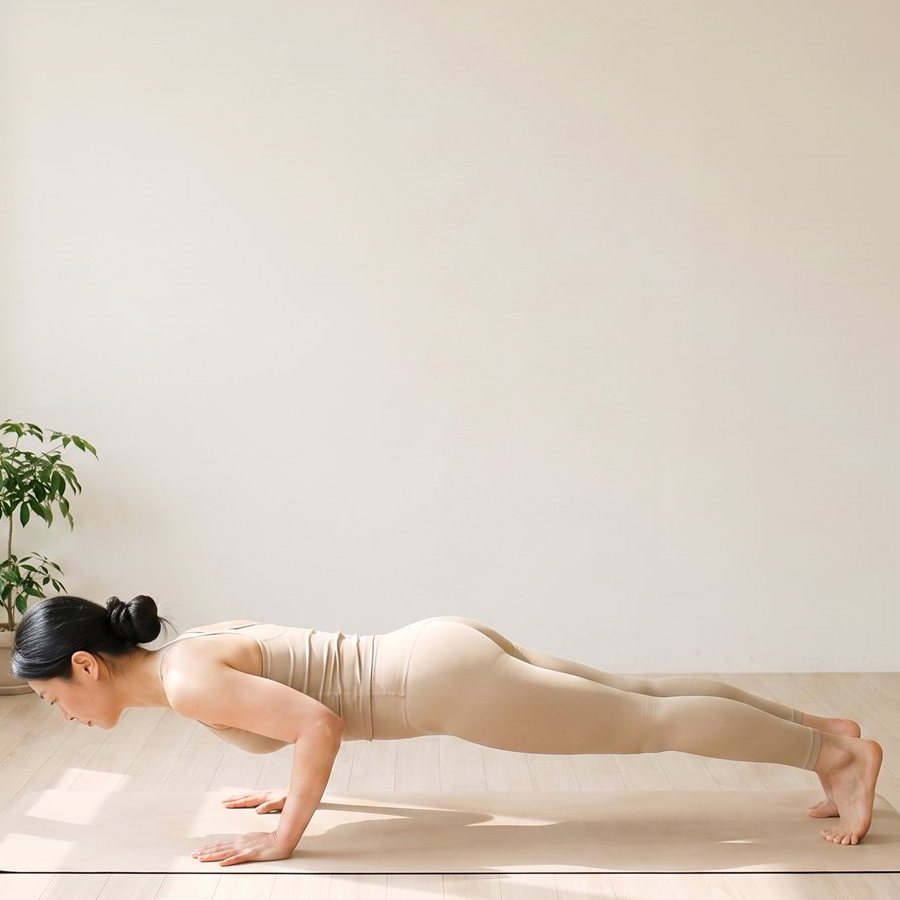
Chaturanga — the transition where wrists and shoulders most need your honesty
The vinyasa transitions are where beginners most often get hurt, precisely because they repeat so many times in a practice — so this section matters more today than in any post so far. The vulnerable places are the wrists and shoulders, above all in chaturanga, the low push-up lowering: done tired and sagging, with the shoulders diving below the elbows, it grinds the front of the shoulder a little more every repetition. I ignored exactly that dull ache in my own shoulder in my early years, called it "opening," and paid for it with months away from full practice — it was one of the more expensive lessons my body has taught me, and I pass it to you at no charge. The rules I give every student: drop the knees to the floor in every lowering for as long as you need — months, not days — and keep the elbows over the wrists and the shoulders no lower than the elbows. A dull ache in the front of the shoulder, pinching in the wrist, or any pain that persists after practice is a signal to step back to the knees-down version, not to push through. Continuous flowing movement also builds heat quickly: if you feel dizzy or your breath turns ragged, pause in a resting position — child's pose is honest and traditional enough — and let the Ujjayi sound become smooth again before rejoining. The count will still be there. It has been there for a hundred years; it can wait thirty seconds for you.
With breath, bandhas, drishti, and now the counted vinyasa, you have the complete inner method of Ashtanga — everything except a place to do it. Tomorrow we get practical: how to start a home Ashtanga practice, from choosing a space and a time of day to deciding honestly how long your first practices should be. And Practice Mode at ashtanga-shala.net counts every vinyasa for you, pose by pose — a good way to feel the counted method in motion.
This post is general guidance, not medical advice. If you have an injury or health condition, check with a professional before practicing.
One breath, one movement — everything else in this practice is commentary.


