The Standing Sequence: Where the Practice Actually Begins
By the time you finish the sun salutations, your practice has really only cleared its throat. Surya Namaskara A and B warm the body and set the breath running; the standing sequence is where that heat gets shaped into a posture practice. Everything the Primary Series will later ask of you on the floor — an open hamstring, a rotating spine, a steady gaze, bandhas that hold without gripping — is first taught here, standing, where you can still see what you are doing.
I tell newer students to think of the standing poses as the alphabet. They are not a warm-up to be rushed through on the way to the "real" poses. If your standing sequence is sloppy, everything downstream inherits that sloppiness.
The First Fold: Padangusthasana
From samasthiti you step or hop the feet to hip distance, hook the big toes, and fold. It looks simple. It is where most people first meet their hamstrings honestly.
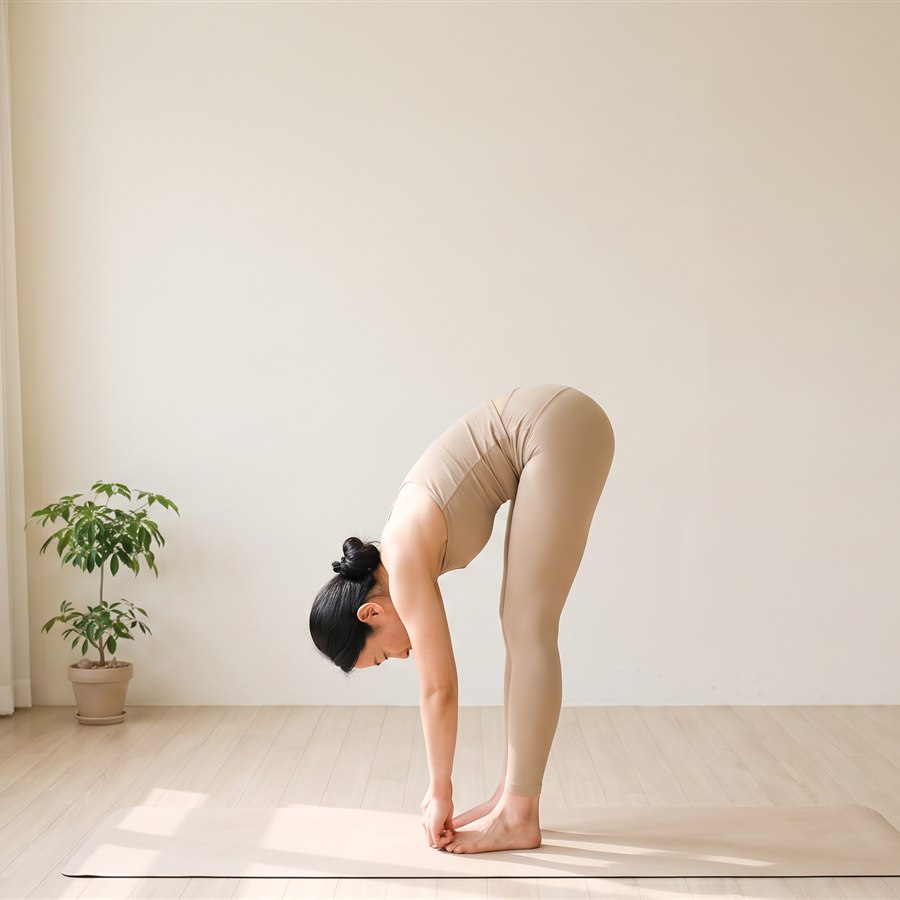
Padangusthasana — the first standing fold, big toes hooked by two fingers.
The breath: inhale as you lift the head and lengthen the front of the body, straightening the arms; exhale as you fold, drawing the elbows out to the sides. Stay five ujjayi breaths, then inhale head up again before releasing. The ujjayi should stay smooth and audible here — if the sound thins out or disappears in the fold, you have gone deeper than your breath can follow. Come up a little. The breath is the measure, not the distance from your nose to your shin.
Keep a soft micro-bend in the knees if the low back rounds hard. A rounded back with locked knees is not a deeper pose; it is a different pose, and not a kind one.
Triangle: Length Before Depth
Utthita Trikonasana is the pose I most often have to un-teach. Students reach for the floor, the ribcage collapses, and the whole thing becomes a side-bend of the waist rather than a long line from the back heel to the fingertips.
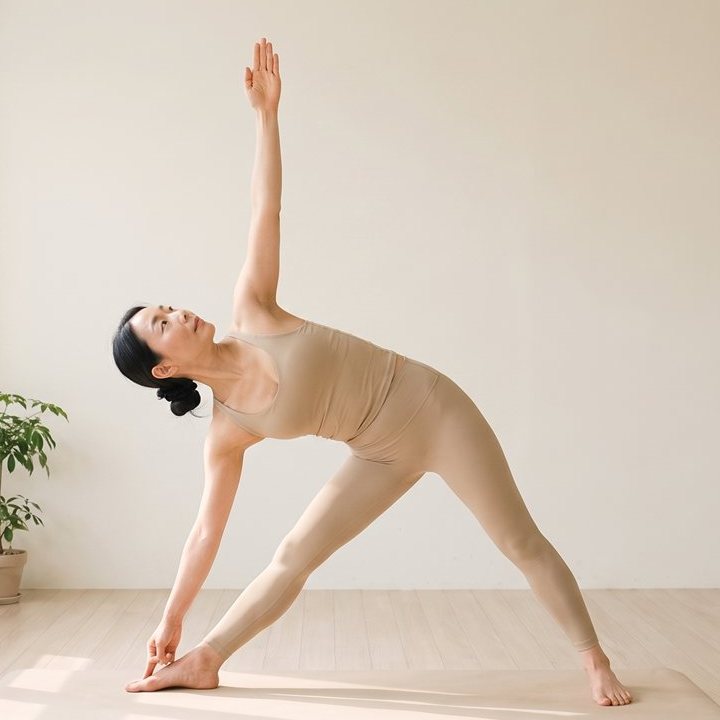
Utthita Trikonasana — both sides of the waist long, gaze to the raised hand.
The breath: inhale to step or jump the feet wide and open the arms, exhale into the pose. Five breaths, then inhale to come up, and repeat on the second side. The drishti is the raised thumb — and this is the first pose in the sequence where the gaze genuinely changes the balance. Look at the floor and you will wobble; look at the thumb and the pose settles.
If the hand does not reach the toe without the chest turning down, take the shin. I would far rather see a student holding her ankle with an open chest than gripping her big toe with her ribs folded shut.
Prasarita Padottanasana: The Sequence Exhales
After the four twisting and side-bending standing poses, the wide-legged forward folds arrive like an open window. There are four variations, five breaths each, and they teach the hamstrings and inner thighs to lengthen without the pull of a twist.
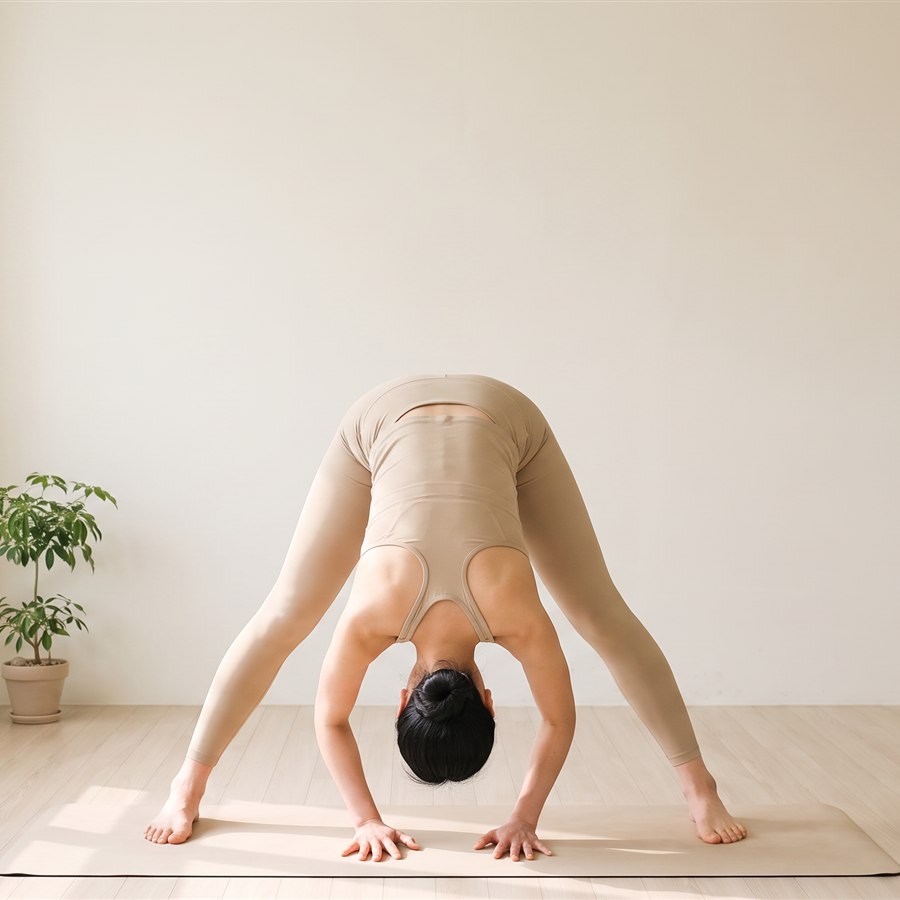
Prasarita Padottanasana — hands under the shoulders, crown of the head toward the mat.
Then Parsvottanasana closes the wide-stance work, folding over one straight leg with the hands in reverse prayer behind the back.
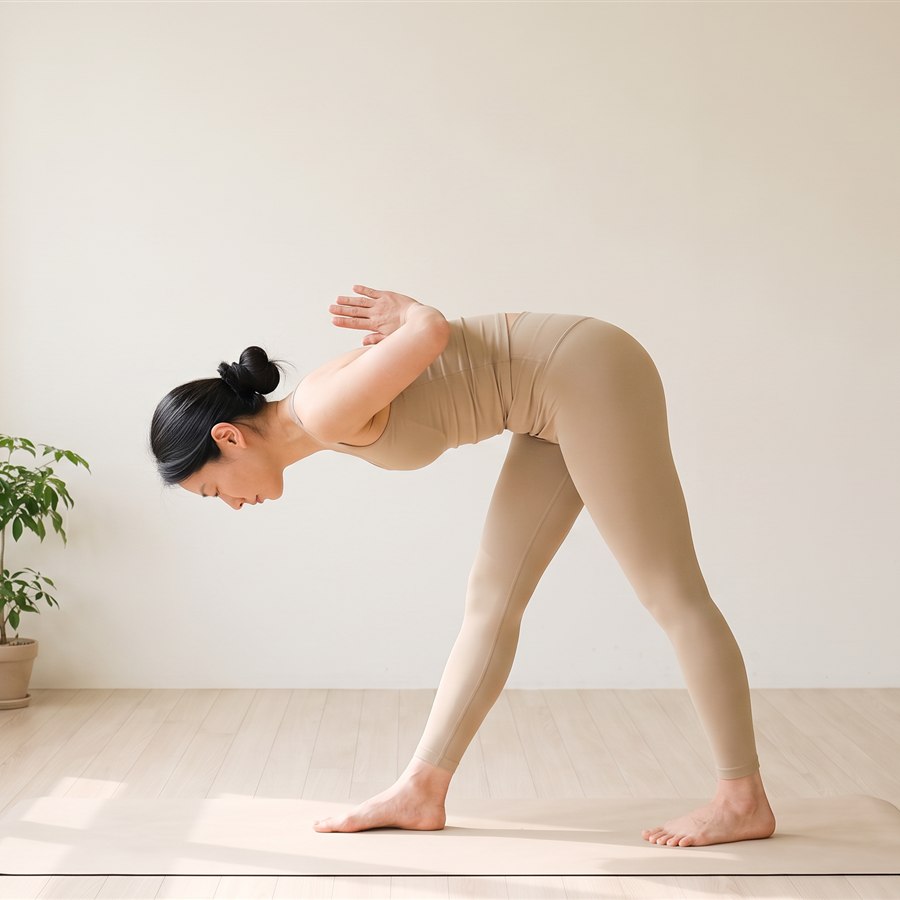
Parsvottanasana — hips square, spine long over the front leg.
The breath: inhale to lengthen and lift the chest, exhale to fold. Always. Every fold in this sequence is an exhalation, and every lengthening is an inhalation — that pairing is the vinyasa principle applied inside a held pose, not just between poses.
Watch Out
Three places ask for care in the standing sequence.
- The hamstring attachment. A dull stretch through the belly of the muscle is fine. A sharp, pinpoint ache right where the hamstring meets the sitting bone is not — that is the tendon complaining, and it takes a long time to settle. In my early years I ignored exactly that sensation for months and paid for it. Bend the knee, shorten the fold, and let it be boring for a while.
- Hyperextended knees. In Trikonasana, if your knee joint sinks backward past straight, lift the kneecap by engaging the thigh and keep a hair of bend. Standing poses done on hyperextended knees load the joint, not the muscle.
- The neck and the head rush. In the wide-legged folds, do not put weight on the crown of the head — the head touches the floor, the hands carry the load. And come up slowly; if you get lightheaded, stay lower and take an extra breath before rising.
Beginners can shorten the sequence honestly: five breaths, both sides, hands wherever they land, ujjayi unbroken. That is a complete standing practice. Depth arrives on its own schedule, and it arrives faster for the student who never forced it.
Stand in each pose long enough to feel the ground answer you back.
🧘 Want to practice these poses right now? Open our interactive guide with photos, alignment details and a breath timer: Ashtanga Shala Practice Guide.
This post is general guidance, not medical advice. If you have an injury or health condition, check with a professional before practicing.


