The Bandhas: Your Inner Locks
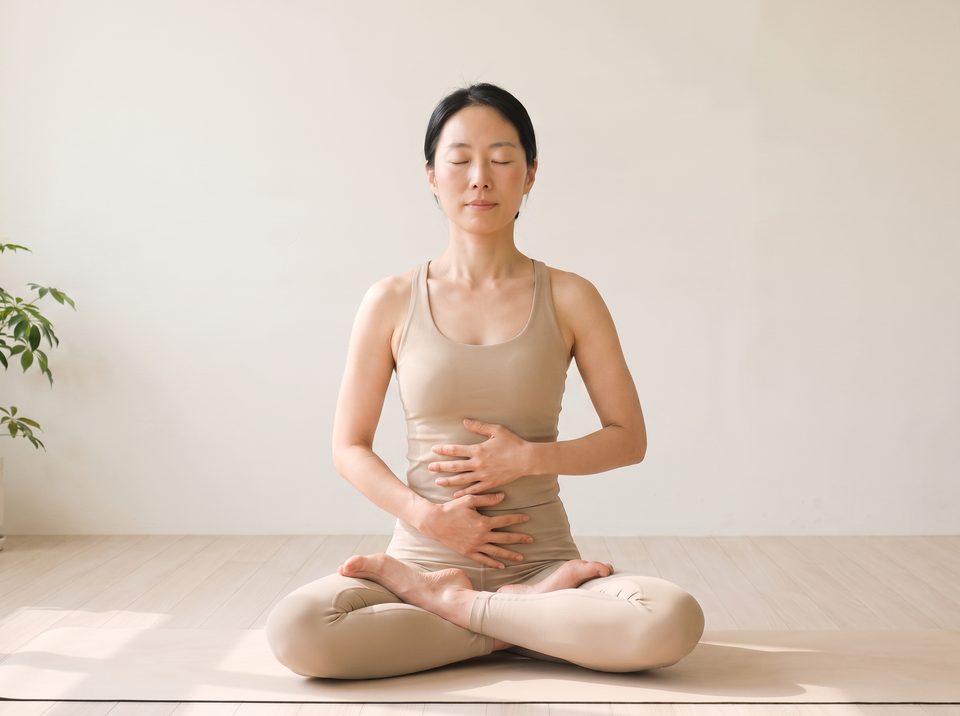
The bandhas: a hum in the deep core, not a shout
So far in this series we have mapped what Ashtanga yoga is and learned the Ujjayi breath that powers it. Today we meet the practice's most misunderstood idea: the bandhas, usually translated as "locks." Together with the breath, they are what make an Ashtanga practice feel light instead of heavy — and after long practice with them, I can promise the beginner's version is far simpler than the mystique suggests.
What is a bandha?
The Sanskrit word bandha means "to bind" or "to hold." In the traditional texts, bandhas are described as energetic seals that contain and direct prana, the life force. On the mat, you can think of them in a more practical way: they are subtle, sustained muscular engagements deep in the core of the body that protect your lower back, connect your breath to your movement, and make you lighter on your hands and feet. Ashtanga uses two of them throughout the entire practice: Mula Bandha and Uddiyana Bandha. (A third, Jalandhara Bandha, the chin lock, appears only in specific breathing practices — you do not need it yet.)
Let me be honest about my own history with this, because it may save you months of doubt. For my first two years of practice I was quietly convinced the bandhas were a fiction. I squeezed everything I could squeeze and felt nothing but tiredness. Then one ordinary morning, in a posture I had done a thousand times, something underneath the breath simply held — and I was lighter. Not stronger; lighter. The bandhas arrive quietly, always later than you want, and always while you were busy just practicing. So take today's instructions lightly, and let them ripen.
Mula Bandha: the root lock
Mula means "root." Mula Bandha is a gentle lift of the pelvic floor — the hammock of muscle at the very base of your torso. It works hand in hand with the breath: the end of the exhale is where you will find it most easily, and a trace of it stays through the inhale.
- Sit tall, close your eyes, and take a few slow Ujjayi breaths — audible, through the nose, inhale and exhale equal.
- At the very end of an exhale, notice the area between the sitting bones. Gently draw it upward — the sensation people describe as stopping the flow mid-way when using the bathroom.
- Now soften that effort by half. And then by half again. What remains — a barely-there inner lift — is closer to Mula Bandha than any hard squeeze.
- Try to keep that whisper of a lift while breathing normally, the Ujjayi sound smooth and unbroken. If the breath stops, you are gripping too hard — the breath is your referee here, always.
Uddiyana Bandha: the flying-up lock
Uddiyana means "flying up." In its full classical form it is a dramatic hollowing of the belly practiced on empty lungs, standing, as a separate exercise — and that version is not what you use during practice. The practice version is much gentler: a light drawing-in of the lower belly, the area a few finger-widths below the navel, so that it stays softly toned rather than pushed out. It keeps the lower back supported in forward folds and gives every jump and lift its spring.
- Stand or sit tall and exhale slowly through the nose, with the soft Ujjayi sound.
- At the end of the exhale, feel the lower belly naturally move back toward the spine. Keep just that — do not suck the whole abdomen in.
- Inhale, letting the ribs and chest expand while the area below the navel keeps its gentle tone — the upper breath free, the low belly quiet.
- Practice keeping this light engagement across three or four full breaths, the sound even the whole way.
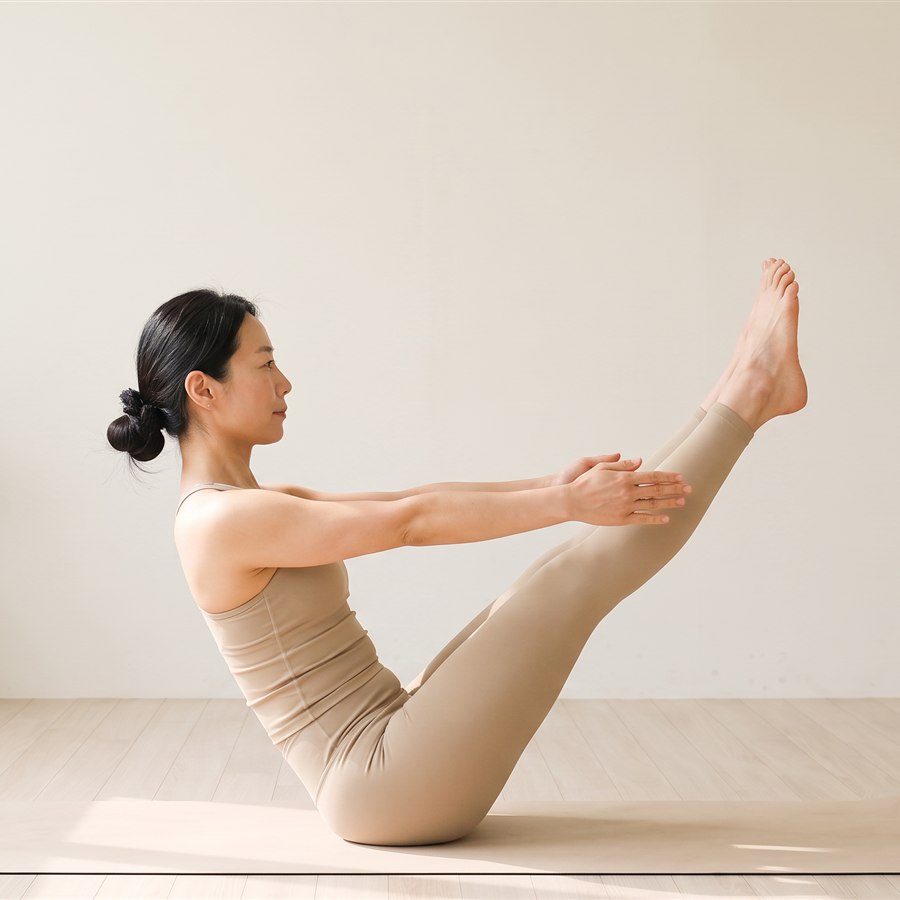
Navasana, the boat — a posture that quietly tells you whether the bandhas are working
When you eventually meet postures like Navasana — the boat pose, held for five slow breaths, five times — you will understand why we build this now. Without the bandhas, Navasana is a fight against gravity, and gravity wins; with even a beginner's trace of them, the posture organizes itself around a quiet center. In the rooms where I learned, teachers rarely lectured about bandhas; they simply placed a hand lightly on a student's low belly and said, "Here. Breathe." That one touch taught more than any book I have read on the subject.
Common misunderstandings
"Harder is better." The single most common mistake, and the one I made longest myself. A clenched pelvic floor or sucked-in stomach blocks the breath and exhausts you within minutes. The bandhas are a hum, not a shout — engaged at perhaps ten or twenty percent.
"I should feel something dramatic." For months, you may not be sure you are doing it at all. That is genuinely normal — I have watched hundreds of students through this exact stretch of doubt. The bandhas reveal themselves gradually, usually first in poses where you suddenly feel lighter than expected.
"Bandhas replace core exercises." They are not a workout. Think of them as a posture of the deep core — an organizing quiet engagement, not a crunch.
"I must hold them perfectly all practice." Everyone loses them constantly — I still do, most reliably in the postures I find hardest. The practice is simply noticing they are gone and inviting them back, breath after breath.
A simple daily exercise
For the next week, add two minutes to the five-minute Ujjayi sitting practice from yesterday's post: once your breath is steady and audible, find the gentle pelvic-floor lift at the end of an exhale and keep a trace of it while you continue breathing — inhale expanding the ribs, exhale settling, the low belly softly toned throughout. That is the whole exercise. Breath plus bandha, quietly held together, is the actual engine of everything that comes later in this series.
Watch out
The bandhas are subtle work, and subtle work has its own ways of going wrong. The signals to back off: if the breath stops or shortens, you are over-gripping — release everything, re-establish the smooth Ujjayi sound, and start again at half the effort; if you feel downward pressure or any pain in the pelvic floor, stop entirely — a bandha lifts gently up, never bears down; if your lower back aches during the belly work, you are bracing rather than gently toning. Be especially gentle — and skip the full standing Uddiyana Bandha entirely — if you are pregnant, recently postpartum, or recovering from abdominal or pelvic surgery; there, work only with qualified in-person guidance. Pelvic floor work should never cause pain. And the beginner's substitute, which I give without hesitation: if the inner search frustrates you, simply keep the lower belly softly drawn in while you breathe, and forget the rest. That alone will protect your back in the folds to come, and the finer layers will find you in their own time.
Tomorrow we complete the inner toolkit with the most outwardly visible of Ashtanga's techniques: drishti, the nine gazing points that tell your eyes — and your mind — exactly where to rest. When you start practicing the poses themselves, the pose cards at ashtanga-shala.net pair each position with its alignment details — a good place to feel the bandhas at work in real postures.
This post is general guidance, not medical advice. If you have an injury or health condition, check with a professional before practicing.
Ten percent effort, one hundred percent attention — that is the whole secret of the locks.


