Sun Salutation B (Surya Namaskara B): When the Practice First Asks More of You
Yesterday I wrote about Surya Namaskara A, the first sequence you will ever learn. Today we come to its older sibling. If A teaches you the grammar of the practice — one breath, one movement, the steady sound of ujjayi — then Surya Namaskara B is the first time the practice looks you in the eye and asks: can you keep that grammar when it gets hard?
Most mornings in the shala, I can tell where a student is in their salutations without looking up. The breath during A is long and almost leisurely. Somewhere in the third round of B, it shortens. That shortening is the whole lesson. B is not about the new postures. It is about keeping the breath you built in A while your legs are burning.
What Changes in B
Surya Namaskara B is counted in seventeen vinyasas, and it adds two postures you have not met before.
The first is Utkatasana — often translated as chair pose, though the word really means something closer to "fierce" or "powerful" posture. Instead of reaching up with straight legs as in A, you bend the knees deeply, sink the hips, and sweep the arms overhead on an inhale. The gaze — your drishti — goes to the thumbs.
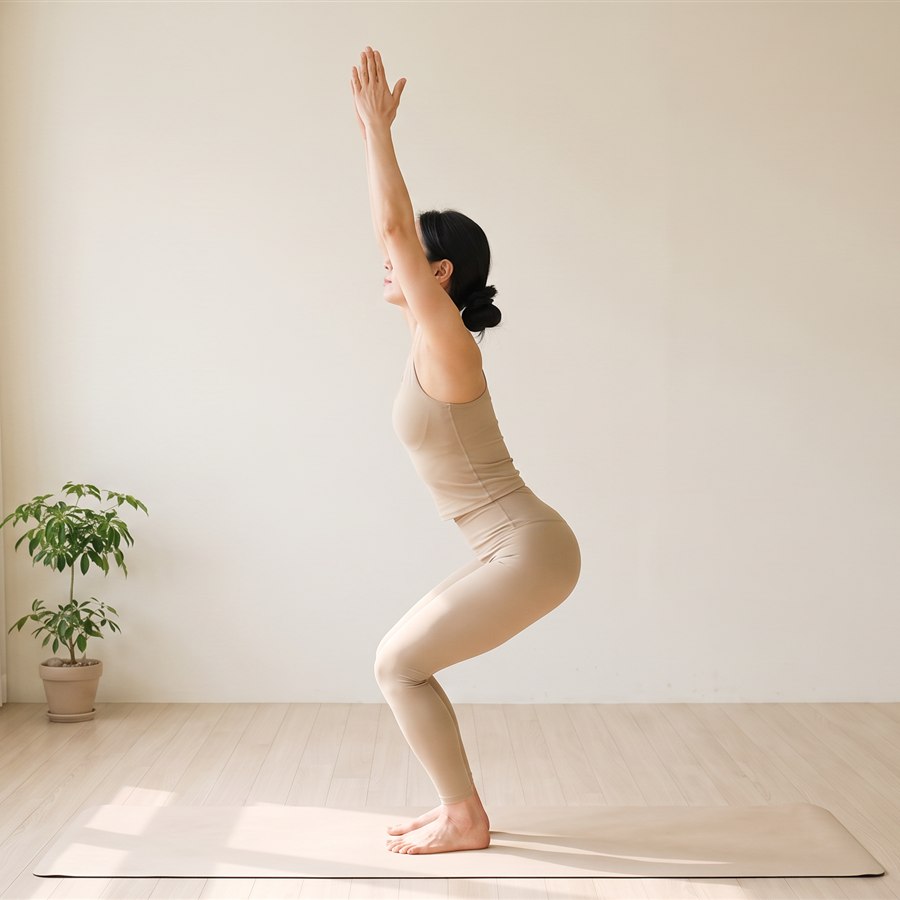
Utkatasana — knees bent, arms overhead, gaze to the thumbs.
The second is Virabhadrasana A, the first warrior. It appears twice in each round — once on the right side, once on the left. From downward dog, you inhale, step one foot forward between the hands, ground the back heel at an angle, and rise with the arms overhead, front knee bent over the ankle, hips squaring toward the front of your mat.
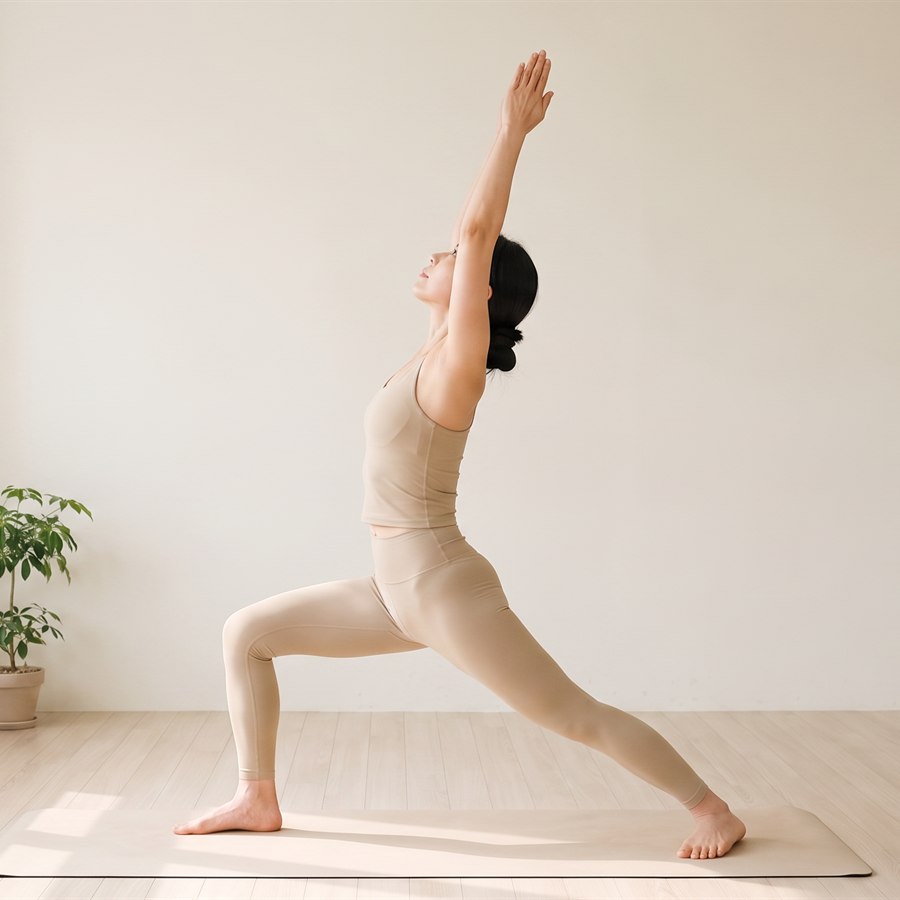
Virabhadrasana A — the back heel rooted, the front knee stacked over the ankle.
The Breath Is the Map
Here is the shape of one round, breath by breath:
- Inhale — bend the knees, arms up: Utkatasana.
- Exhale — fold forward, straightening the legs as you go.
- Inhale — lift the head, lengthen the spine.
- Exhale — step or jump back and lower to Chaturanga.
- Inhale — upward dog. Exhale — downward dog.
- Inhale — right foot steps forward, back heel down, rise into the first warrior. Exhale — hands to the floor, back to Chaturanga.
- Inhale — upward dog. Exhale — downward dog. Then the same warrior on the left side, and the same passage through Chaturanga again.
- In the final downward dog, stay for five slow breaths. Then inhale forward, exhale fold, inhale rise once more into Utkatasana, and exhale to Samasthiti.
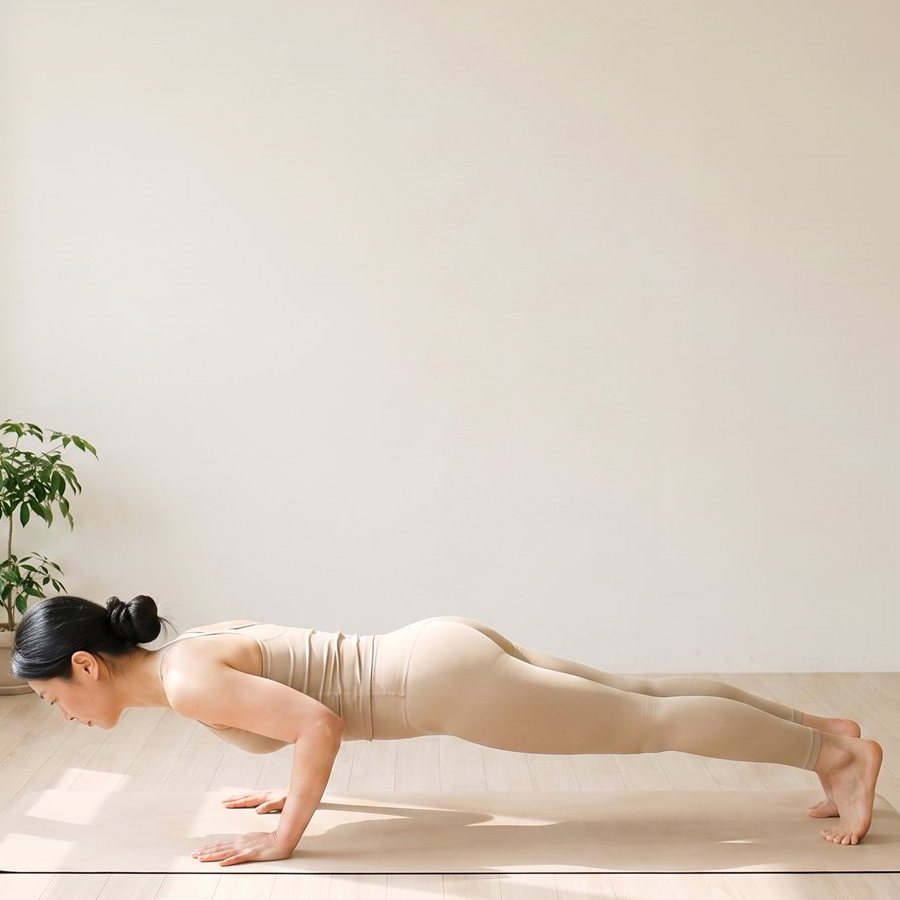
Chaturanga - elbows over wrists, shoulders no lower than the elbows.
Notice something: in B, you pass through Chaturanga three times in a single round. This is where the ujjayi sound tells the truth. If it turns ragged or stops, you are moving faster than you are breathing. Slow down. The sound should stay even and oceanic from the first vinyasa to the last — softer than you think, steady as a kettle just before it boils. The bandhas, those inner locks we spoke of earlier, are what let the breath stay long while the legs work; when I feel students collapse in Utkatasana, it is almost always the lower belly that let go first, not the thighs.
Watch Out
B is where beginners most often hurt themselves, because fatigue arrives before technique does. A few things I ask my own students to guard:
- The front knee in the warrior. Keep it tracking over the ankle, not wobbling inward. If the knee drifts past the toes and you feel pressure in the joint rather than work in the thigh, shorten your stance. A shorter stance is not a lesser posture.
- The lower back in Utkatasana. Sinking the hips without the support of the belly pinches the lumbar spine. Bend the knees less deeply and lengthen the tailbone down. Depth comes later; length comes first.
- Chaturanga, three times a round. This is triple the load of A. There is no shame — none — in lowering the knees to the floor for every single one. I did so myself for months while a shoulder healed. Sharp pain in the front of the shoulder is a stop sign, not a challenge.
- The back heel. In the first warrior, keep the outer edge of the back foot pressing down. When the heel floats, the knee takes what the foot refused.
My own knees taught me most of this. When I was young I muscled through B with a deep, proud Utkatasana and a warrior stance far too long for my hips. The practice let me get away with it for a few years, and then it did not. What I lost to that impatience took far longer to recover than honest, shallow postures would ever have cost me.
How Many, and How Fast
Traditionally we take five rounds of A and then three to five of B. If three full rounds of B leave you gasping, do two, or do them with the knees down, and keep the breath unbroken. A hundred shortened breaths teach you less than ten long ones. The sequence is not going anywhere; it has been waiting for all of us for a very long time.
When the legs begin to burn, breathe as though nothing is happening — that is the practice.


