How to Start a Home Ashtanga Practice
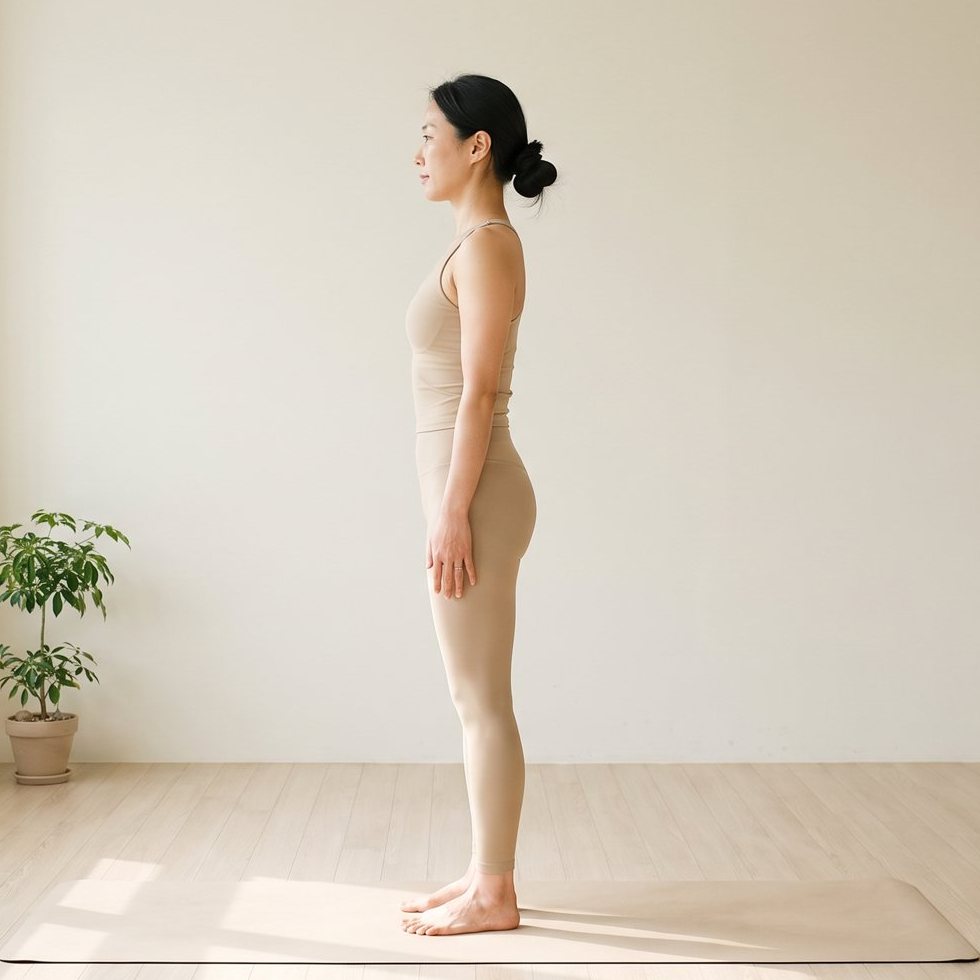
Samasthiti - where every practice begins
Over the last five posts we built the inner method of Ashtanga: the Ujjayi breath, the bandhas, drishti, and the counted vinyasa system. Today we get practical. You have the method — now you need a place, a time, and an honest plan you will actually keep.
The space: smaller than you think
You need room for a mat, plus enough clearance overhead to raise your arms and enough behind you to step back into a lunge. That is roughly two metres by one. It does not need to be a dedicated room, a beautiful room, or a tidy room. A cleared patch of living-room floor is a complete Ashtanga studio.
Two things matter more than size. First, a floor that does not slide — a mat on carpet shifts under you in downward dog, so a hard floor is better if you have one. Second, somewhere you can leave the mat, or at least somewhere the mat is easy to fetch. The distance between "I should practice" and "I am on the mat" is the single biggest predictor of whether a home practice survives its first month.
The equipment: almost none
A mat with decent grip is the only genuine requirement. Ashtanga is famously equipment-light — no blocks in the traditional method, no straps, no bolsters. That said, beginners are not traditionalists, and two household items help enormously in the early months:
- A belt or scarf — for reaching a foot you cannot yet reach in seated forward folds and the standing balance.
- A folded blanket or firm cushion — to sit on when your hips are tight, which tilts the pelvis forward and makes seated poses far more honest.
Practice with bare feet, in clothes you can bend in. That is the whole kit.
The time of day: earlier than you would like
Traditionally Ashtanga is practiced in the morning, before eating, ideally around sunrise. There are two reasons, and one of them is practical rather than mystical. The practical one: Ashtanga involves deep folding and twisting, which is uncomfortable on a full stomach. Aim for at least two to three hours after a meal, which for most people means first thing in the morning or late afternoon.
The other reason is about consistency. A morning practice happens before the day has a chance to fill up with reasons not to. Evening practice is entirely valid — many people practice at night and progress beautifully — but if your practice keeps evaporating, moving it earlier is the first fix to try.
Your body will be stiffest in the morning. That is normal and it is not a reason to switch. Ashtanga is designed to warm you gradually from the inside; the first ten minutes are supposed to feel like work.
How long: start embarrassingly short
A full Primary Series practice takes about ninety minutes. Do not start there. The most reliable way to build a daily practice is to make the daily part easy and let the length grow on its own.
A realistic first month looks like this:
- Week 1: five to ten minutes. Just the sun salutations, slowly, with the breath audible.
- Week 2: fifteen minutes. Sun salutations plus the first two or three standing poses.
- Week 3–4: twenty to thirty minutes. The standing sequence as far as you have learned it, finishing with a few minutes lying down.
Twenty minutes practiced six days a week transforms a body. Ninety minutes practiced once a fortnight does very little. Length is the least important variable in the first year — frequency is everything.
How often, and when to rest
The traditional schedule is six days a week, with one full rest day. Most practitioners take Saturday, though any consistent day works. Rest is part of the method, not a failure of it: the practice is repetitive and demanding, and tissue rebuilds on the day off.
Ashtanga also observes moon days — the full moon and the new moon are traditionally rest days, which gives you roughly two extra days off each month. Whether you find the reasoning compelling or not, having scheduled rest built into a daily practice is a genuinely good idea, and moon days give you permission to take it without guilt.
Finally, the traditional guidance is that women rest during the heaviest days of menstruation. Treat this as permission rather than obligation, and let your own body decide.
Common mistakes in the first month
Practicing too long, too soon. The classic pattern is a heroic ninety-minute first session, three days of soreness, and a mat that stays rolled up for a fortnight. Short and repeatable beats long and heroic every single time.
Chasing the pose instead of the breath. If your breath goes silent, you have gone too far into a posture. Back off until the sound returns. The breath is your safety limit, and it is a more reliable one than sensation.
Skipping the rest at the end. Lying down for a few minutes after practice is not optional padding — it is when the nervous system absorbs what you just did. Even two minutes counts.
Waiting until conditions are right. There is no perfect mat, no perfect hour, no perfect body to begin with. The practice starts unimpressively, for everyone.
When to be careful
If you are returning from injury, pregnant, or managing a condition that affects your joints, blood pressure, or balance, talk to a professional before starting, and be conservative in the first weeks. Soreness in the muscles a day after practice is ordinary; sharp pain in a joint during practice is not — stop, and do not practice through it.
🧘 One more thing that helps a home practice stick: having the sequence somewhere you can glance at it. Our companion guide lays out every pose with photos, alignment details and a breath timer — Ashtanga Shala Practice Guide.
You have a space, a time, and a plan. Tomorrow we cover the last piece of the frame before we begin moving: the opening and closing mantras — what they mean, how they are used, and whether a home practitioner needs them at all.
This post is general guidance, not medical advice. If you have an injury or health condition, check with a professional before practicing.


