Drishti: Where to Look While You Practice
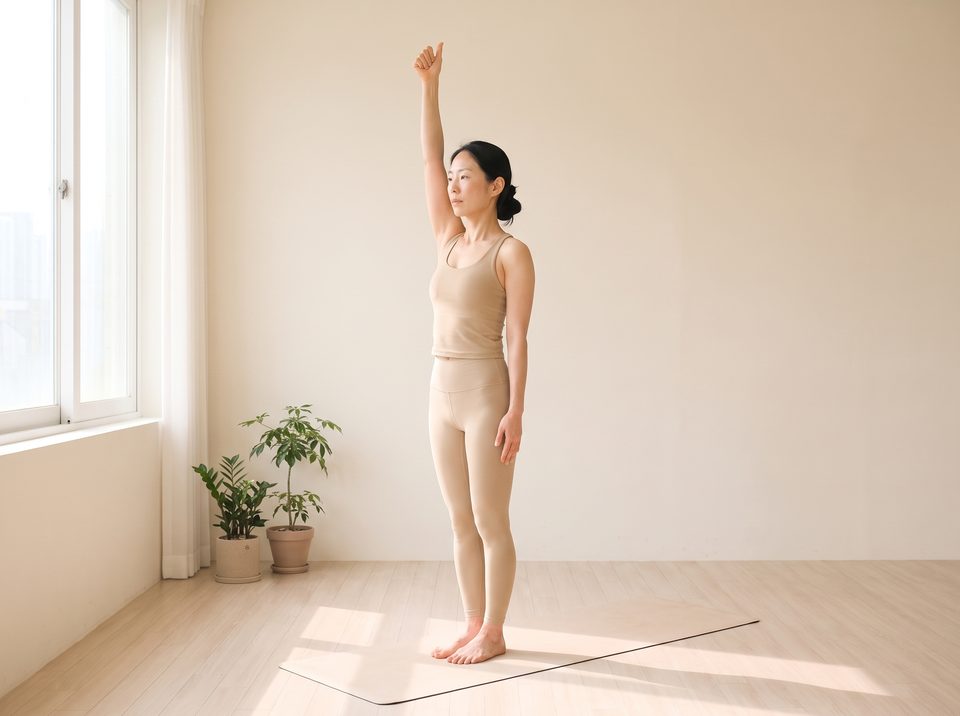
Drishti — the eyes come home, and the mind settles behind them
Over the last three posts we built the inner toolkit of Ashtanga: the map of the practice, the Ujjayi breath, and the bandhas. Today we add the last piece, and the one you can actually see from the outside: drishti, the gazing point. Ask why experienced practitioners look so calm mid-practice, and this is a large part of the answer — their eyes have somewhere to be. It is also the technique I underestimated longest in my own practice.
What is drishti?
Drishti is a Sanskrit word meaning "sight" or "gaze." In Ashtanga, every posture comes with an assigned point for the eyes to rest on — the tip of the nose, the thumb, the navel, and so on. The gaze is soft, not a stare: eyes relaxed, focus gentle, the point simply a home base the eyes return to.
Why does this matter? Because the eyes lead the mind. When your gaze wanders around the room — to the clock, the window, your neighbor's mat — your attention scatters with it. When the eyes rest on one point, the mind settles behind them. Drishti turns a physical workout into a moving meditation, and it also quietly improves your balance: in standing poses, a steady gaze is worth more than strong ankles.
I learned this the humbling way. In my early years in crowded rooms, I could have told you at any moment whose forward fold was deeper than mine — which tells you exactly where my eyes were. One morning a teacher murmured beside me, "Your posture is here, but your eyes are on his mat." It remains the small embarrassment I am most grateful for. Comparison enters through the eyes; close that door, and practice becomes something between you and your breath alone.
The nine gazing points
- Nasagra — the tip of the nose. The most common drishti, and the default whenever you are unsure.
- Angustha madhya — the thumb. Used when the arms reach overhead, as in the first movement of Surya Namaskara.
- Bhrumadhya — the point between the eyebrows, the "third eye."
- Nabi chakra — the navel. Used in Downward-Facing Dog.
- Urdhva — up to the sky.
- Hastagra — the hand, as in Extended Triangle.
- Padayoragra — the toes, used in most seated forward folds.
- Parsva (right) — far to the right side, used in twists.
- Parsva (left) — far to the left side.
Do not memorize this list today. Each pose post in this series will simply tell you the drishti for that pose, and after a few weeks the pattern becomes second nature: broadly, the gaze follows the direction the pose is moving.
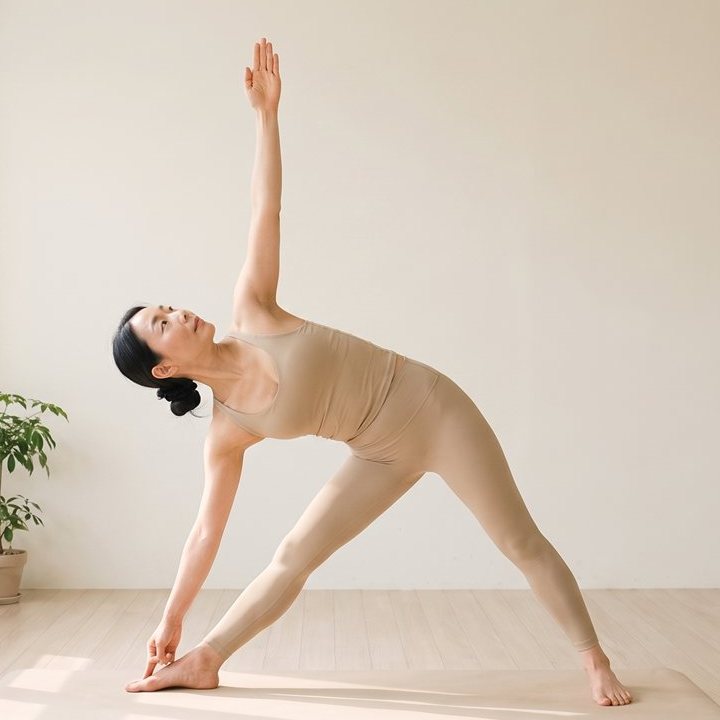
Extended Triangle — hastagra drishti, the gaze resting softly on the raised hand
How drishti rides on the breath
The techniques of tristhana arrive together on the same breath. Take the opening of a sun salutation: as you inhale and the arms rise, the gaze travels up with them to rest on the thumbs. As you exhale and fold, the gaze releases down toward the nose tip. The eyes move at the speed of the breath, never darting ahead of it. Then, through the five slow Ujjayi breaths of a posture, the gaze simply stays home. And a detail worth knowing: when students strain their eyes, I can hear it — the ocean sound of the breath tightens within a breath or two. If your Ujjayi turns harsh, soften the eyes first. It works more often than you would believe.
Common mistakes
Staring. Drishti is a soft gaze, not an intense fixation. If your eyes ache or your face tenses, let the gaze become gentler — half the effort, same direction.
Craning the neck to reach the point. The gazing point should never force the neck into strain. If looking at the thumb overhead bothers your neck, gaze straight ahead instead — the direction of attention matters more than anatomical precision. I use this permission myself on stiff mornings.
Closing the eyes. Tempting in familiar poses, but closed eyes drift toward daydreaming and wobble in balances. Keep them softly open.
Forgetting it exists. The most common one of all. Like the bandhas, drishti is something you lose and recover a hundred times per practice — I still do; I only catch it sooner. The recovering is the practice.
A simple daily exercise
Add one more layer to the short daily sit you have been building this week: breathing with the Ujjayi sound and a trace of bandha, let your eyes rest softly on the tip of your nose for ten slow breaths. Notice how the mind behaves when the eyes stop moving. That noticing — breath, bandha, gaze quietly working together — is the complete inner technique of Ashtanga, and you now have all of it before learning a single pose.
Watch out
Drishti is gentle, but the neck and the eyes both deserve protection. The place people actually hurt themselves is the neck — craning up at the thumb or the sky. The upward gazes are always optional: if you feel pinching at the base of the skull or in the back of the neck, bring the gaze level immediately — that pinch is a signal, not a sensation to breathe through. For the eyes, nose-tip gazing can feel crossed and effortful at first; keep it to a few breaths, and if it brings eye strain, headache, or dizziness, use the beginner's substitute I give all new students: rest the gaze on the floor a comfortable arm's length ahead, soft and unfocused. That single humble drishti will carry you through most of the Primary Series. People with vertigo, migraine, or eye conditions should keep every gaze effortless — the settling of the mind comes from the stillness of the gaze, not from which point you chose, so nothing is lost by choosing the easy one.
Tomorrow we bring counting into the picture: vinyasa, the system that gives every single movement in Ashtanga its own number and breath. And when you begin the postures, each pose card at ashtanga-shala.net lists the drishti for that posture, so you can practice the gaze from your very first pose.
This post is general guidance, not medical advice. If you have an injury or health condition, check with a professional before practicing.
Where the eyes rest, the mind rests — let them come home a hundred times, gently.


