Big Toe Pose (Padangusthasana): The First Standing Fold of the Ashtanga Primary Series
The sun salutations warmed you up. Now the practice starts asking questions. Padangusthasana is the first pose of the standing sequence and the first time the Primary Series looks directly at your hamstrings — with no momentum to hide behind and nowhere to rush.
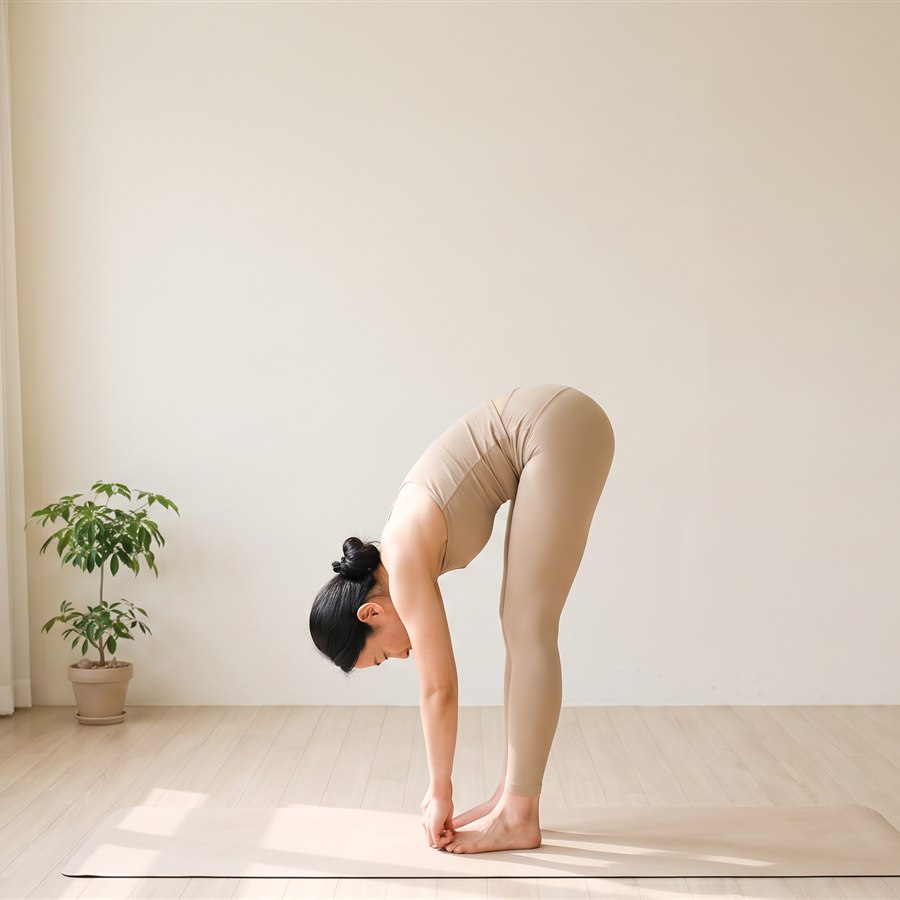
Padangusthasana - big toes hooked by the first two fingers, elbows drawing out to the sides.
What is Padangusthasana?
Pada means foot, angustha means big toe, asana means posture — Big Toe Pose. The name is literal: you hook your big toes with your fingers and fold. It is the plainest instruction in the whole Primary Series, and it is the pose where most practitioners first meet the honest state of the back of their legs.
Its job in the sequence is to lengthen the hamstrings and calm the nervous system after the heat of Surya Namaskara. Folding forward with the head below the heart settles the breath, and everything that follows in the standing sequence — the triangles, the side angles, the wide-legged folds — assumes you have already begun opening here.
Step by step
You arrive from Samasthiti at the top of the mat. In a led class this pose carries three counts, with five breaths held in the fold.
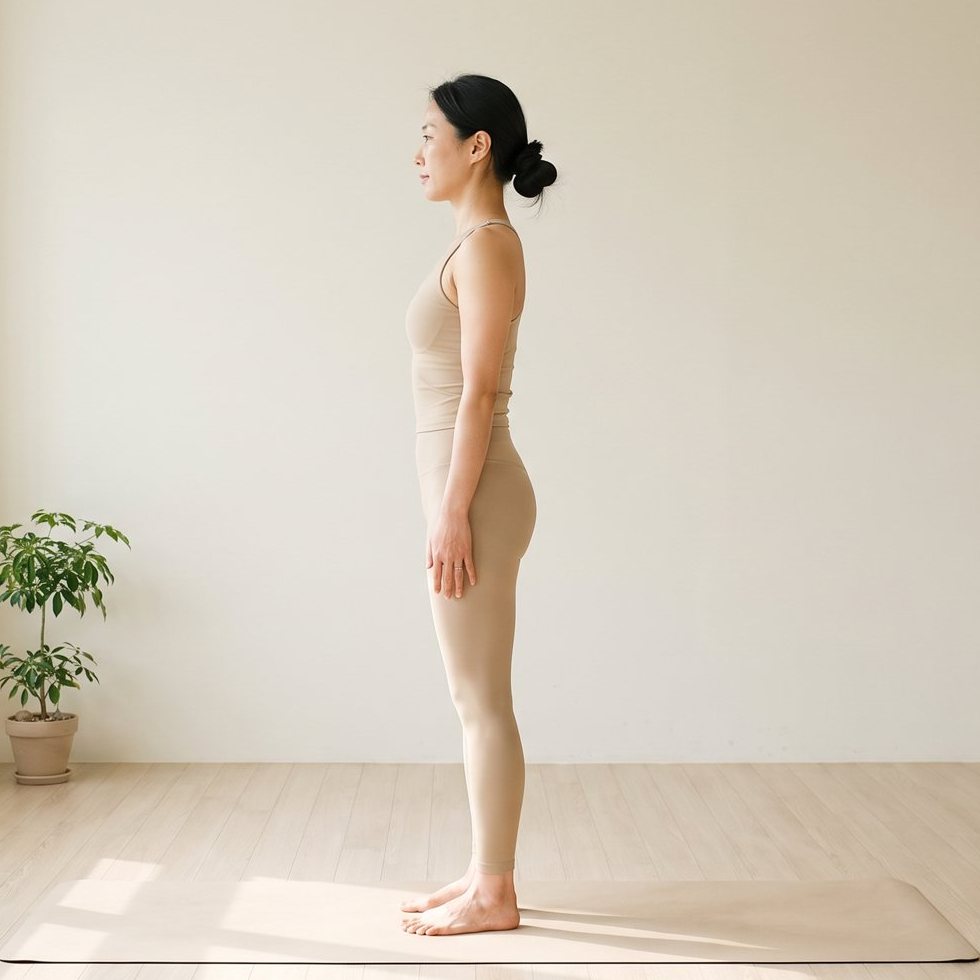
Samasthiti - where the standing sequence begins, before the feet step apart.
- From Samasthiti, exhale and step or lightly hop the feet to hip width — about the distance between your own hip joints, not your outer hips. The outer edges of the feet stay parallel.
- Exhale and fold forward from the hip joints, letting the spine lengthen rather than round.
- Hook each big toe with the first two fingers of the same hand, thumb pressing down on top. If the toes are out of reach, see the modifications below before forcing anything.
- Ekam (inhale) — straighten the arms, lift the chest and the head, and lengthen the front of the body. The back is long and slightly concave here. This is a real position, not a passing moment.
- Dve (exhale) — fold, drawing the elbows out to the sides and lifting the sitting bones. Aim the chin toward the shins, not the forehead toward the knees. Stay here for five breaths.
- Trini (inhale) — lift the head and straighten the arms again, returning to the long-spine position before you release into the next pose.
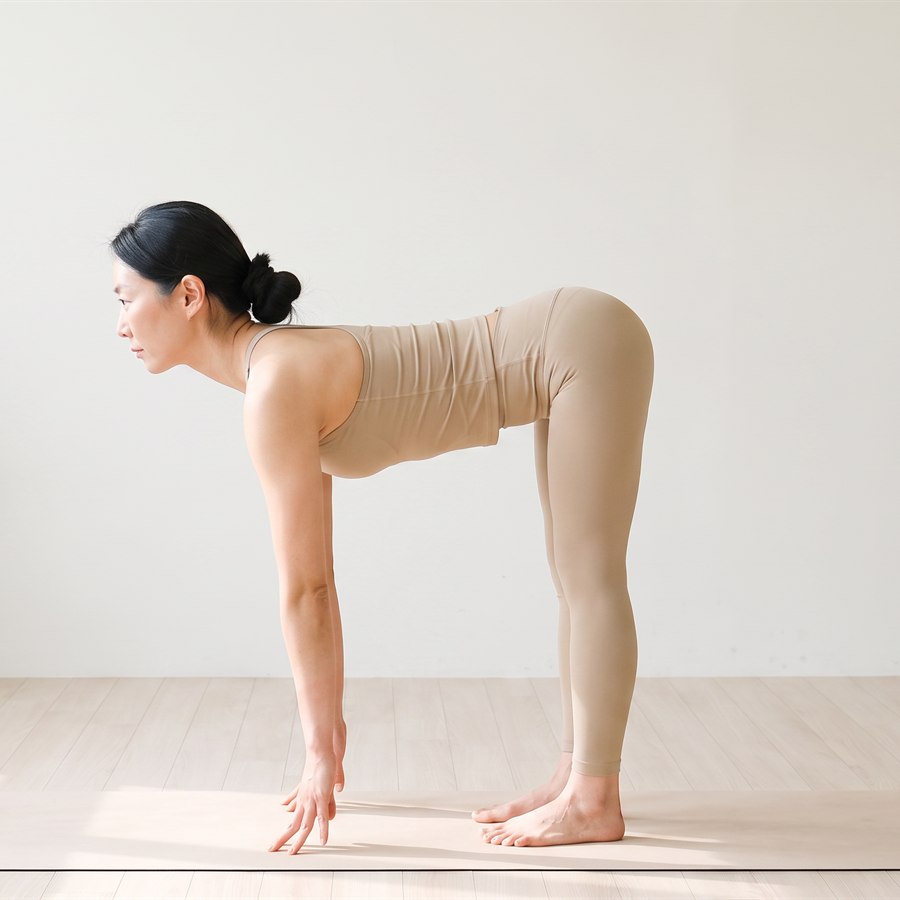
The head-up position - long spine, chest lifted, the shape to find on ekam and again on trini.
Breath and gaze
Your Ujjayi breath is the safety limit in this pose, more reliable than any sensation. In the fold the breath naturally wants to shorten, because the belly is compressed against the thighs. Let it be a little shorter, but never let it go silent. If the ocean sound thins out or disappears, you have folded past what your body can breathe through — come up an inch and the sound will return.
The drishti is nasagrai, the tip of the nose. In practice this means the gaze travels down the line of the nose toward the floor between your feet. Do not crane the neck to look at your shins — the head follows the spine, and the eyes rest softly rather than staring.
Common mistakes
Locking the knees to reach further. This is the big one. Straight legs with a hard-rounded lower back is not a deeper pose, it is a different and less kind one — the stretch moves off the hamstring belly and onto the lower back and the tendon at the sitting bone. A soft micro-bend in the knees with a long spine is worth far more than locked legs and a curled back.
Pulling with the arms. The hands hold the toes; they do not haul the torso down. The fold comes from the hip joints, and the arms simply give the elbows somewhere to widen. If your biceps are working hard, you are pulling.
Feet too wide, or turned out. Hip width means hip width. Wider feet make the pose feel easier by taking the hamstrings out of it, which defeats the purpose. Keep the outer edges parallel.
Skipping the head-up position. Beginners often treat ekam and trini as transitions to hurry through. They are the pose. That long-spine shape is what teaches the hamstrings to lengthen from the pelvis rather than the lower back, and it protects the back every time you come out.
Beginner modifications
If your fingers do not reach your toes, bend the knees as much as you need until they do — bent knees with hooked toes is a complete, honest version of this pose. Over weeks and months the knees straighten on their own, and they do it faster than they would if you fought them.
If the toes are still out of reach with bent knees, hold your shins or ankles instead and keep the same shape: long spine on the inhale, fold on the exhale, elbows wide. Nothing is lost.
Tight hamstrings often show up as a lower back that rounds immediately. The fix is the same: bend the knees. Depth in this pose is measured by the length of your spine, not by the distance from your nose to your shins.
When to be careful
The sensation to respect is a sharp, pinpoint ache right where the hamstring meets the sitting bone. That is the tendon, not the muscle, and it settles slowly once irritated — shorten the fold and bend the knee for a few weeks rather than working through it. A broad, dull stretch through the middle of the back of the thigh is fine.
If you have a lower back injury or disc issue, keep the knees generously bent and consider staying in the head-up position rather than the full fold. Standing forward folds send blood to the head, so if you have high or low blood pressure, or get dizzy easily, come up slowly and take an extra breath before you rise. During pregnancy, step the feet wider than hip width so there is room for the belly.
🧘 Want to practice this pose right now? Open our interactive guide with photos, alignment details and a breath timer: Ashtanga Shala Practice Guide.
Tomorrow we stay exactly where we are and change only the hands: Padahastasana, Hand Under Foot Pose, which follows immediately from this fold and asks something quite different of the wrists and the weight in your feet.
This post is general guidance, not medical advice. If you have an injury or health condition, check with a professional before practicing.


